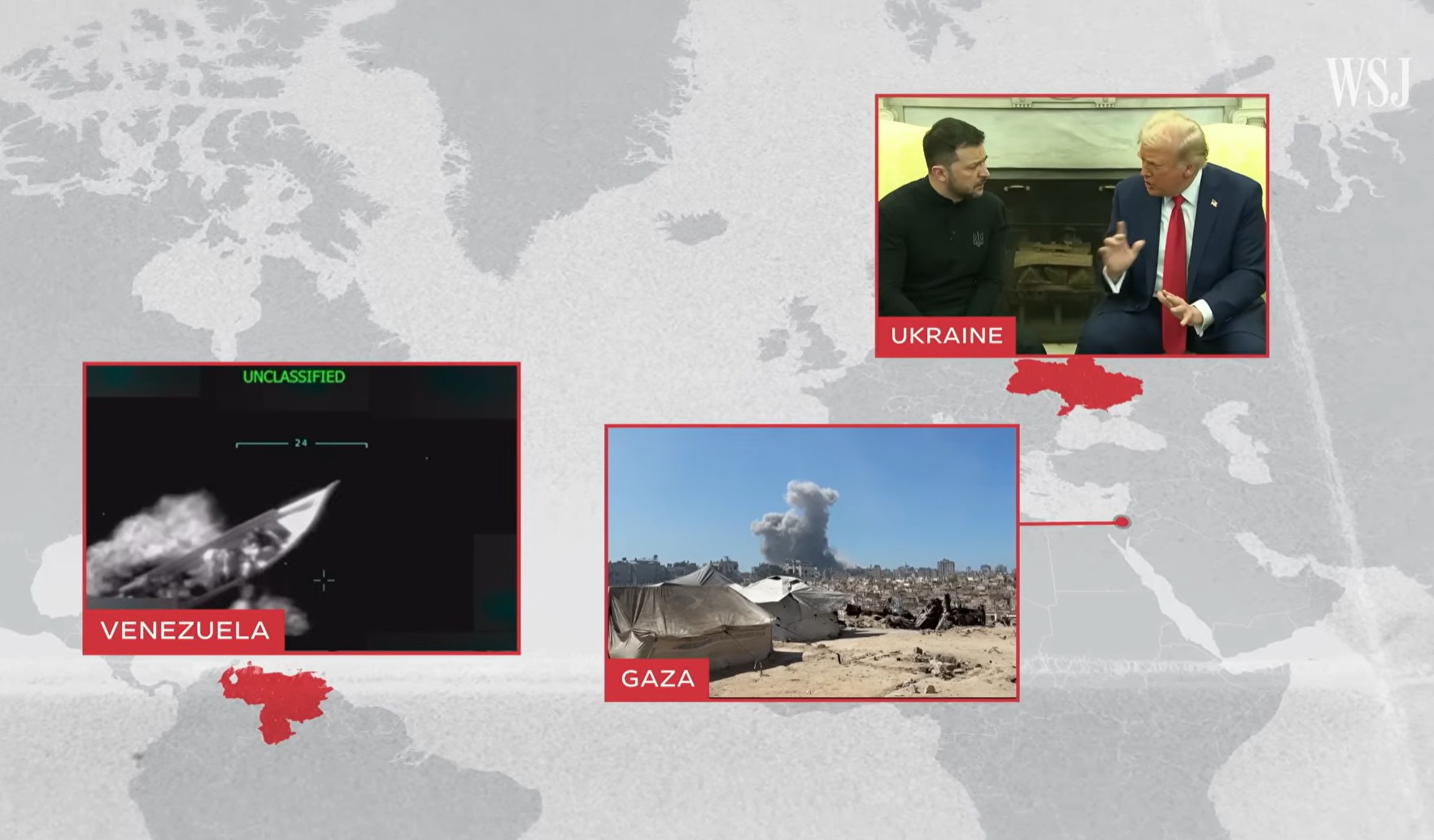
One year into his second term, President Donald Trump has fundamentally reshaped American foreign policy, employing an aggressive strategy that supporters hail as a restoration of strength and critics condemn as reckless overreach. A new report by The Wall Street Journal examines the turbulent first twelve months of the administration, highlighting a foreign doctrine characterized by direct military intervention in the Western Hemisphere, high-stakes diplomacy in the Middle East, and intense pressure campaigns in Eastern Europe.
According to the Journal’s retrospective, the administration has moved swiftly to fashion global affairs “in his image,” prioritizing unilateral action over traditional diplomatic norms.
“President Trump has put the Monroe Doctrine on steroids, and I like it,” said Republican Senator Lindsey Graham, a close ally of the President, in an interview with the Journal. Graham defended the administration’s aggressive posture, particularly in the Caribbean, where the U.S. has ramped up military operations.
Escalation in Venezuela
The administration’s most kinetic shift has occurred in America’s backyard. Following a declared crackdown on “narcoterrorists” beginning in September, the U.S. Navy has deployed significant assets, including an aircraft carrier, to the waters off Venezuela. The campaign has involved airstrikes on drug boats and the seizure of oil tankers, actions that the White House frames as national defense but opponents view as a prelude to war.
“There is a drug caliphate in our backyard,” Graham told the Journal, arguing that if the U.S. can remove President Nicolás Maduro without a full invasion, “that would be great.” He added ominously, “Cuba should be next.”
However, the strategy faces stiff resistance on Capitol Hill. Senator Jeanne Shaheen, the top Democrat on the Senate Foreign Relations Committee, argued that the military buildup is unjustified. “Venezuela doesn’t pose a national security threat to the United States,” Shaheen said. “This is clearly, or it seems to clearly be, about regime change.”
Stalled Peace in the Middle East
In the Middle East, the President has attempted to position himself as a historic peacemaker, brokering a “Peace 2025” framework between Israel and Hamas. The ambitious deal outlines the withdrawal of Israeli forces from Gaza, the return of hostages, and the disarmament of Hamas.
“This took 3,000 years to get to this point,” President Trump said during a signing ceremony depicted in the report. “And it’s going to hold up, too.”
Despite the pageantry, the Journal reports that implementation remains stalled. Senator Graham expressed skepticism regarding the voluntary disarmament of militant groups without the threat of overwhelming force. “I don’t see an Arab force coming over the horizon that will literally disarm Hamas,” Graham noted. “My advice would be put the disarmament on a time clock… and if they don’t meet that schedule, then unleash Israel on them.”
Pressure on Ukraine
The administration’s approach to the Russia-Ukraine war has been equally disruptive. Delivering on campaign promises to seek a rapid end to the conflict, the White House has exerted pressure on both Moscow and Kyiv. While the President publicly claimed he would settle the war “before I even take office,” peace remains elusive.
The Journal indicates that the administration is pushing Ukrainian President Volodymyr Zelensky to accept a deal that may involve territorial concessions in exchange for peace—a strategy that has alarmed European allies and Democrats.
“They are supporting a plan that was written in Moscow,” Senator Shaheen said. She warned that capitulation in Ukraine would have global ramifications, particularly regarding China. “If we walk away from Ukraine, we might as well give them a green light to go into Taiwan.”
Graham, while supporting a negotiated end, insisted on security guarantees, suggesting “tripwire European forces on the ground” in Ukraine to deter future Russian aggression, and stating he would “never recognize legally” Russian control over the Donbas region.
A Safer America?
The Journal’s report ultimately poses the question of whether the United States is safer after twelve months of Trump’s second term. The answer highlights the deep partisan divide in Washington.
Senator Shaheen argues that the President has “vastly undermined America’s national security” by alienating allies and ignoring the rule of law.
Conversely, Senator Graham contends that the aggressive posture has yielded results, citing operations against Hamas, the isolation of Hezbollah, and previously unreported strikes on Iranian facilities. “We’re much safer than we’ve been in decades,” Graham asserted. “We literally bombed Iran’s nuclear facilities… There is a new sheriff in town.”