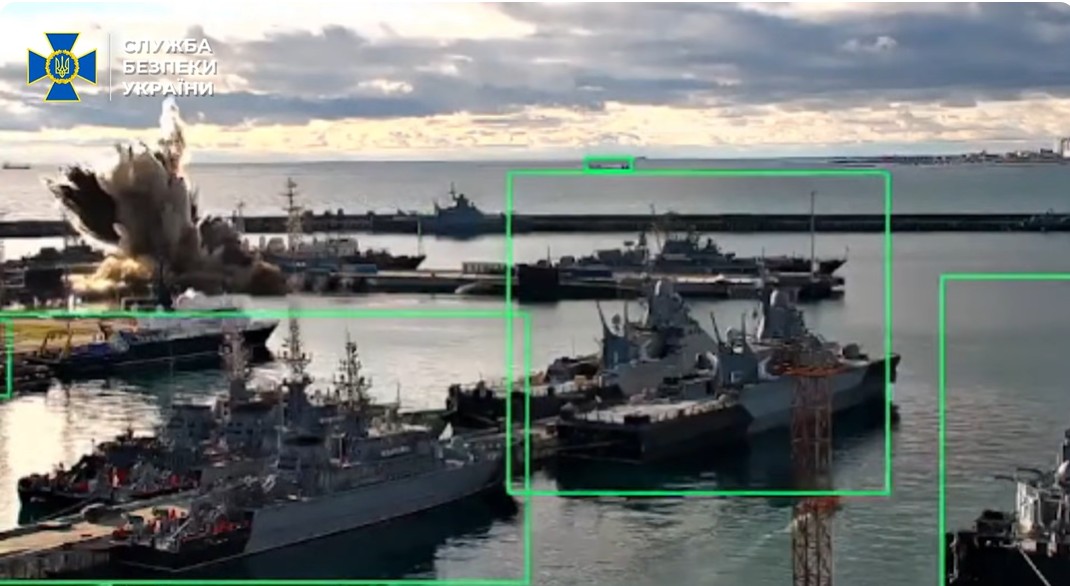
In a significant evolution of the naval conflict in the Black Sea, Ukrainian forces have reportedly utilized a new class of uncrewed underwater vehicle—dubbed a “sub-sea drone”—to strike a Russian Kilo-class submarine docked in the port of Novorossiysk. The attack marks a critical expansion of Kyiv’s reach, challenging the security of Russia’s primary naval hub in the region.
Geopolitical strategist Peter Zeihan, in an analysis released via his Zeihan on Geopolitics channel, highlighted the strategic gravity of the strike, noting that recent satellite imagery confirms damage to the port’s infrastructure, including defensive booms and docks. While Russia has denied the incident and the extent of the damage to the vessel remains unconfirmed, the implications for the Russian Navy are severe due to a lack of accessible repair facilities.
“The Russians no longer have the capacity to refit them because that equipment is in Crimea, and Crimea is under regular air drone assault,” Zeihan stated. “If this Kilo-class sub was even mildly damaged, it’s out.”
The Collapse of Safe Harbors
The strike on Novorossiysk represents a major tactical shift. Following repeated Ukrainian strikes on Sevastopol in occupied Crimea, the Russian Navy had relocated the bulk of its Black Sea Fleet to Novorossiysk, a major commercial port and oil export hub on the Russian mainland, in search of safety.
According to Zeihan, the introduction of sub-surface capabilities by Ukraine renders this sanctuary obsolete. “The fact that a sea attack happened in Novorossiysk is extraordinarily bad for the Russians,” Zeihan observed, noting that the port has now become “completely untenable for any sort of Russian naval or maritime activity.”
If Novorossiysk is no longer viable, the Russian fleet may be forced to retreat further down the coast to Tuapse, a smaller port that lacks the necessary military infrastructure. Zeihan predicts that this displacement signals a collapse in Russian naval power in the region, projecting “the functional end of the entire Russian Black Sea Fleet within the next 12 months.”
Technical Limitations and Tactical Reality
Despite the success of the strike, analysts caution against viewing the new drone as a tool for open-ocean warfare. Unlike modern torpedoes, these drones face significant communication hurdles once submerged, limiting their ability to track moving targets.
“If it goes underwater, it’s not receiving signals from anyone else,” Zeihan explained, emphasizing that the drone likely struck the submarine while it was stationary at the dock. Consequently, while the technology poses a lethal threat to stationary infrastructure, its utility in open naval combat remains restricted.
“It is not an at-sea weapon, it is an anti-port weapon,” Zeihan concluded. However, he noted that by denying Russia the use of its primary logistical and military port, the strategic impact of the weapon is profound, regardless of its technical limitations.