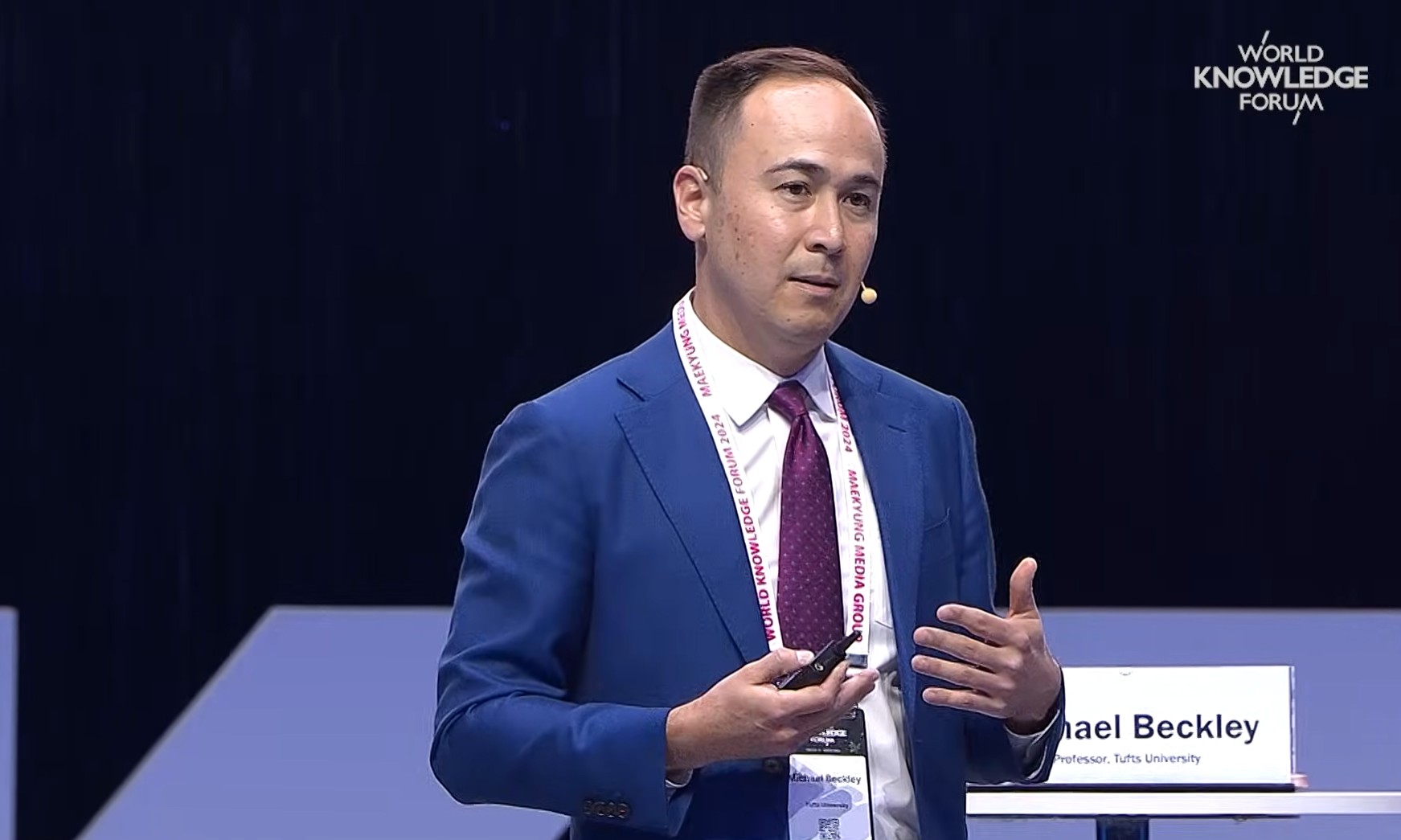
Challenging the prevailing narrative of an inevitable “Asian Century,” Tufts University Professor Michael Beckley delivered a stark prognosis at the World Knowledge Forum: China’s era of meteoric ascent is not merely stalling, but has begun to reverse.
In a presentation titled “The End of China’s Rise and the Future of World Order,” Beckley argued that the geopolitical landscape is shifting from a globalized order to one of intense security competition, driven by a Beijing that is running out of time, resources, and friends.
“We’re often told that we’re living in an Asian century that’s going to revolve around a forever rising China,” Beckley told the audience. “But I think when the history books about the 2020s are written, they’re going to say that this was the decade that China’s epic rise finally came to an end, and that changed everything.”
The Economics of Reversal
Beckley presented data suggesting that China’s economy is shrinking relative to the United States, a trend visible even within Chinese government statistics. He pointed to a decade of negative productivity growth and a skyrocketing capital-output ratio, indicating that Beijing is spending exponentially more capital to generate diminishing units of growth.
The structural “tailwinds” that propelled China for forty years—a secure geopolitical environment, pro-growth government policies, abundant resources, and a massive demographic dividend—have all turned into “headwinds,” according to Beckley.
Most critical is the demographic collapse. Beckley noted that for the last 35 years, China benefited from “the greatest demographic dividend in human history,” with roughly 10 to 15 workers for every retiree. That trend is evaporating.
“Just over the next 10 years, China is going to lose more than 70 million working-age adults,” Beckley stated. “It’s going to gain more than 130 million senior citizens. That’s like taking an entire France of workers, consumers, taxpayers out of the country and adding an entire Japan of elderly pensioners.”
Furthermore, the environmental costs of China’s rapid industrialization are coming due. Beckley highlighted that the country has depleted half its river water and rendered 60 percent of its groundwater “unfit for human contact.”
The Global “China Hangover”
The reversal of China’s fortunes is creating shockwaves for the global economy, a phenomenon Beckley termed the “China hangover.” For decades, trading partners enjoyed a “triple win” of access to the Chinese market, cheap infrastructure loans, and low-cost construction.
That era is over. “The China hangover is here,” Beckley said. “China is buying less from the world than it used to… It’s not offering debt relief to other countries; it’s demanding that its partners now pay back the money with interest.”
Instead of serving as an engine for global growth, Beijing is now attempting to export its way out of its domestic slowdown, flooding global markets with subsidized manufacturing goods like electric vehicles. This has led to surging trade deficits for partners ranging from Germany to South Korea.
The “Peaking Power” Trap
Beckley’s most alarming assessment concerned how Beijing might react to its declining trajectory. He rejected the notion that a slowing China would become a more peaceful, responsible stakeholder. Instead, he categorized China as a “peaking power”—a nation that has gained massive strength but now faces a closing window of opportunity.
“What we’ve seen from past peaking powers in history is that they don’t just mellow out and dial back their ambitions,” Beckley warned. “They tend to crack down on dissent at home, and then expand aggressively abroad.”
Drawing parallels to the United States in the late 19th century, Russia in the early 20th century, and Germany and Japan in the 1930s, Beckley argued that economic stagnation often fuels imperialism rather than retrenchment. He cited China’s current “peacetime military buildup,” the largest since Nazi Germany, as evidence of this shift.
Domestically, Beckley described a pivot toward “fascism,” citing the worship of Xi Jinping, the repression of ethnic minorities like the Uyghurs, and the rise of a hyper-nationalist narrative focused on revenge against hostile foreign forces.
“I now use the term fascism,” Beckley stated. “If you look at what’s happening in China today, a lot of the classic hallmarks of a fascist regime are starting to show themselves.”
A Moment of Maximum Danger
This combination of economic desperation and military capability has led Beijing to abandon “economic carrots” in favor of “military sticks.” Beckley pointed to aggressive maneuvers in the South China Sea, coercion against the Philippines, and the normalization of military pressure on Taiwan.
Additionally, China is engaging in “external balancing” by supporting fellow autocratic revisionists, including Russia, Iran, and North Korea, effectively stretching Western resources across multiple theaters.
Beckley concluded that the world is entering a “moment of maximum danger” as China attempts to carve out its security perimeter before its power wanes further.
“If we can make it through these terrible 20s,” Beckley said, expressing cautious optimism, the international system might eventually stabilize into a cold war dynamic. However, he emphasized that the immediate path forward is volatile, as China’s leaders may feel compelled to act before their window closes permanently.