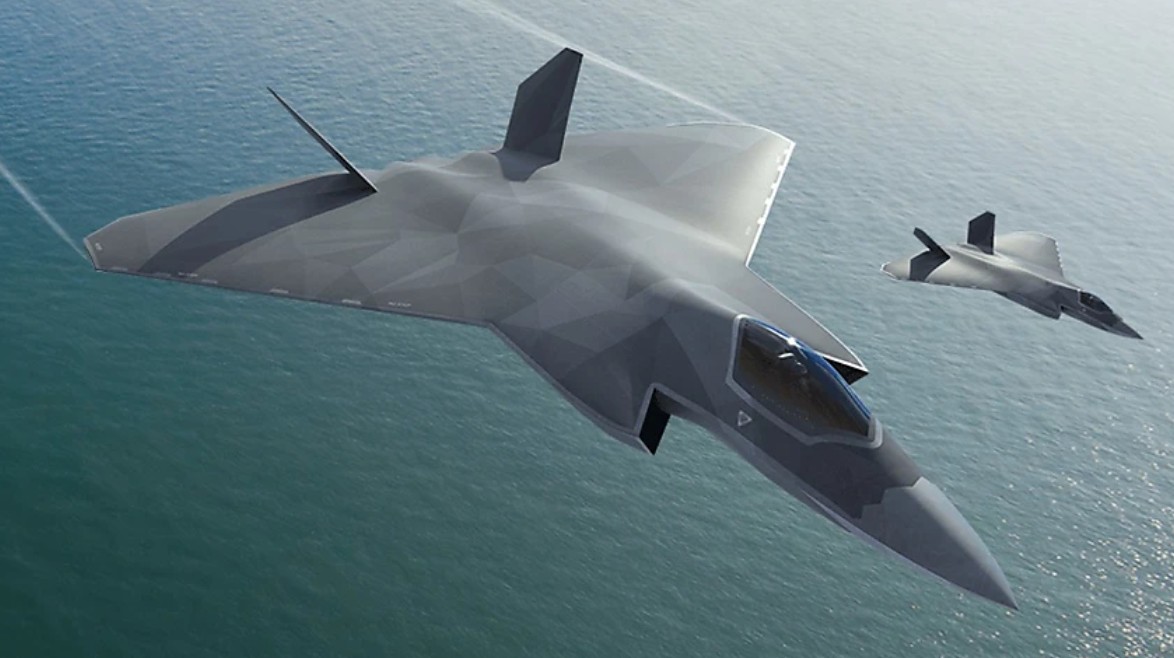
The era of the “Top Gun” dogfighter is ending. In its place: flying data centers the size of tennis courts, piloted by tactical managers commanding swarms of autonomous drones. The United States, China, and a UK-led coalition are racing to develop sixth-generation combat aircraft—and the winner won’t be decided by aerobatics, but by information dominance.
According to a special report by The Telegraph’s “Battle Lines” podcast, the next leap in air power will move beyond current fifth-generation capabilities seen in aircraft like the F-35 Lightning II. While today’s jets focus on stealth and sensor fusion, the coming generation will operate as a “family of systems,” integrating manned aircraft with Collaborative Combat Aircraft (CCAs)—highly advanced autonomous drones.
From Fighter Pilot to “Quarterback”
Sophy Antrobus, a research associate at King’s College London and former RAF officer, explained that sixth-generation technology is defined by its ability to process and distribute vast amounts of intelligence in real-time.
“Fifth-gen are what some people would call relatively selfish with the information that it has. Sixth-generation systems are designed to be generous rather than selfish with the data, capable of building an operational picture that extends far beyond the formation itself.”
— Sophy Antrobus, Research Associate at King’s College London
This shift will fundamentally alter the human role in the cockpit. Rather than engaging in direct visual combat, pilots will function as “mission commanders” directing loyal wingman drones to penetrate dangerous anti-access zones.
“The pilot actually won’t be doing an awful lot of flying. If the system decides the pilot is doing something stupid, it tends to just take control itself.”
— Sophy Antrobus
Bigger, Not Smaller
Contrary to sci-fi expectations of smaller, sleeker craft, the physics of future warfare—particularly across the vast Indo-Pacific—dictates that these jets will be significantly larger than their predecessors. To maintain stealth, fuel and weapons must be carried internally rather than on external pylons.
24 meters
Expected length of GCAP Tempest — the size of a tennis court
For comparison, the US F-35 measures roughly 16 meters long.
A Three-Way Race
The podcast highlighted three main competitors: the US “Next Generation Air Dominance” (NGAD) program, the GCAP partnership between the UK, Italy, and Japan, and China’s secretive development—tentatively identified as the J-36 or J-50.
Context
GCAP (Global Combat Air Programme), also known as Tempest, unites British, Italian, and Japanese aerospace industries. The partnership aims to pool resources and expertise against both US dominance and Chinese advancement in military aviation.
Tom Withington, an air warfare expert at the Royal United Services Institute (RUSI), suggested that despite different industrial and political approaches, the resulting capabilities might be strikingly similar.
“Technologically, it’s probably quite difficult to get a cigarette paper between them.”
— Tom Withington, Air Warfare Expert at RUSI
The technological hurdles remain immense, particularly in communication. To share the terabits of data required, these aircraft will utilize advanced laser and quantum communications. Withington described the necessary precision of these links as “needle-like”—a requirement to bypass enemy jamming by powers like Russia or China.
The Price of Air Superiority
Development comes with an enormous price tag and complex industrial politics. Yet experts argue that the strategic necessity of air superiority justifies the investment—particularly as a deterrent.
“The cost of war is so much more expensive than the cost of preventing war. If we are committed to these kind of next-generation capabilities, we are demonstrating our commitment to match the capabilities being developed by those who seek to harm us.”
— Sophy Antrobus
Demonstrator aircraft for these programs are expected to fly around 2027 or 2028, with full operational capability projected for the mid-to-late 2030s.