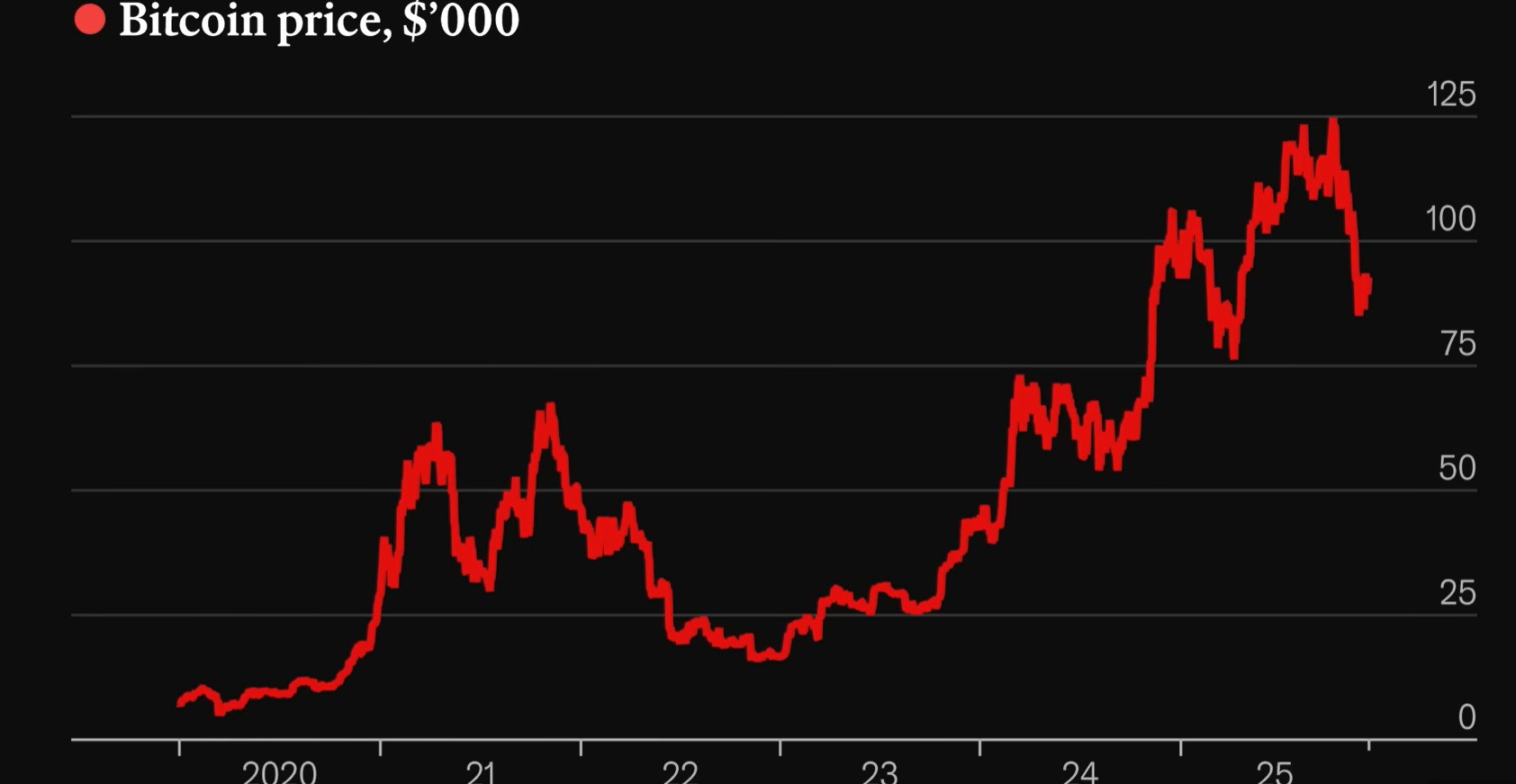
By the close of 2025, the cryptocurrency sector appeared to have secured a historic victory. The asset class had permeated Wall Street, secured federal regulatory approval, and found its most powerful champion in the White House. Yet, according to a new analysis by The Economist, the industry is grappling with a stark paradox: it has gained full institutional legitimacy just as its market performance has delivered a punishing blow to a new generation of investors.
In a discussion released on December 19, editors from The Economist dissected the unique nature of the current market downturn, noting that while adoption has skyrocketed, the price action tells a cautionary tale.
A Mainstream Leviathan
The scale of the crypto market has expanded exponentially since the onset of the decade. Henry Curr, the publication’s economics editor, highlighted the dramatic shift in valuation over the last five years.
“If you go back to 2020… the total market cap of outstanding crypto was about 300 billion dollars,” Curr observed. “Now, it’s over 4 trillion dollars. So it’s really gone from something that was novel and new and becoming known, to something that’s really sizable, an increasingly sizable part of the financial system.”
However, this growth has been accompanied by extreme volatility. Following an all-time high in October 2025, Bitcoin has shed approximately 30 percent of its value, trading near $90,000 by year’s end.
Why This Crash is Different
While digital assets are notorious for boom-and-bust cycles, Mike Bird, Wall Street editor for The Economist, argued that the 2025 sell-off possesses a distinct, more damaging characteristic compared to previous winters.
In past cycles, such as the downturns of 2022, long-term holders generally remained profitable despite sharp corrections. That safety net has evaporated for the influx of mainstream adopters.
“Now it’s not true,” Bird stated, referencing the chart of Bitcoin’s price trajectory. “There are lots of Bitcoin holders who will have bought in the last 12 months especially that are still sitting on significant losses. It’s an interestingly sort of depressed period for the asset.”
The Political Merger
This market depression comes against the backdrop of unprecedented political support. The editors noted that the industry’s fortunes have become inextricably linked with American politics, specifically the return of Donald Trump to the presidency.
“This year has been the year that the crypto industry really got everything it wanted,” Bird noted. “It got regulatory approval with the election of Donald Trump.”
The analysis detailed a shift from Trump’s first term, where he labeled Bitcoin a “scam,” to a “very sustained effort over the last two years to merge the interests of the Trump family and the US right in general with the interests of crypto.”
This merger extends beyond rhetoric to personnel and personal finance. The discussion highlighted the involvement of the Trump family in ventures such as World Liberty Financial, as well as the appointment of crypto-friendly figures to key regulatory posts, including the SEC and CFTC. Bird pointed out that within the cabinet, there are “a huge number of people with significant crypto interests,” citing Commerce Secretary Howard Lutnick as a prime example.
The End of Existential Risk
Despite the current price slump, the overarching takeaway remains the sector’s solidification within the global financial infrastructure. The threat of an outright ban, once a looming cloud over the industry, has vanished.
“It feels like a very, very long time ago that people seriously discussed whether… would Bitcoin be made illegal,” Bird remarked. “That’s a ludicrous discussion now. It’s so far from something that’s plausible.”
With Wall Street firms now tokenizing deposits and ETFs firmly established, crypto has achieved the stability it sought. However, as The Economist editors concluded, legitimacy has not immunized the asset class from the laws of gravity, leaving late-arriving retail investors to bear the brunt of the correction.