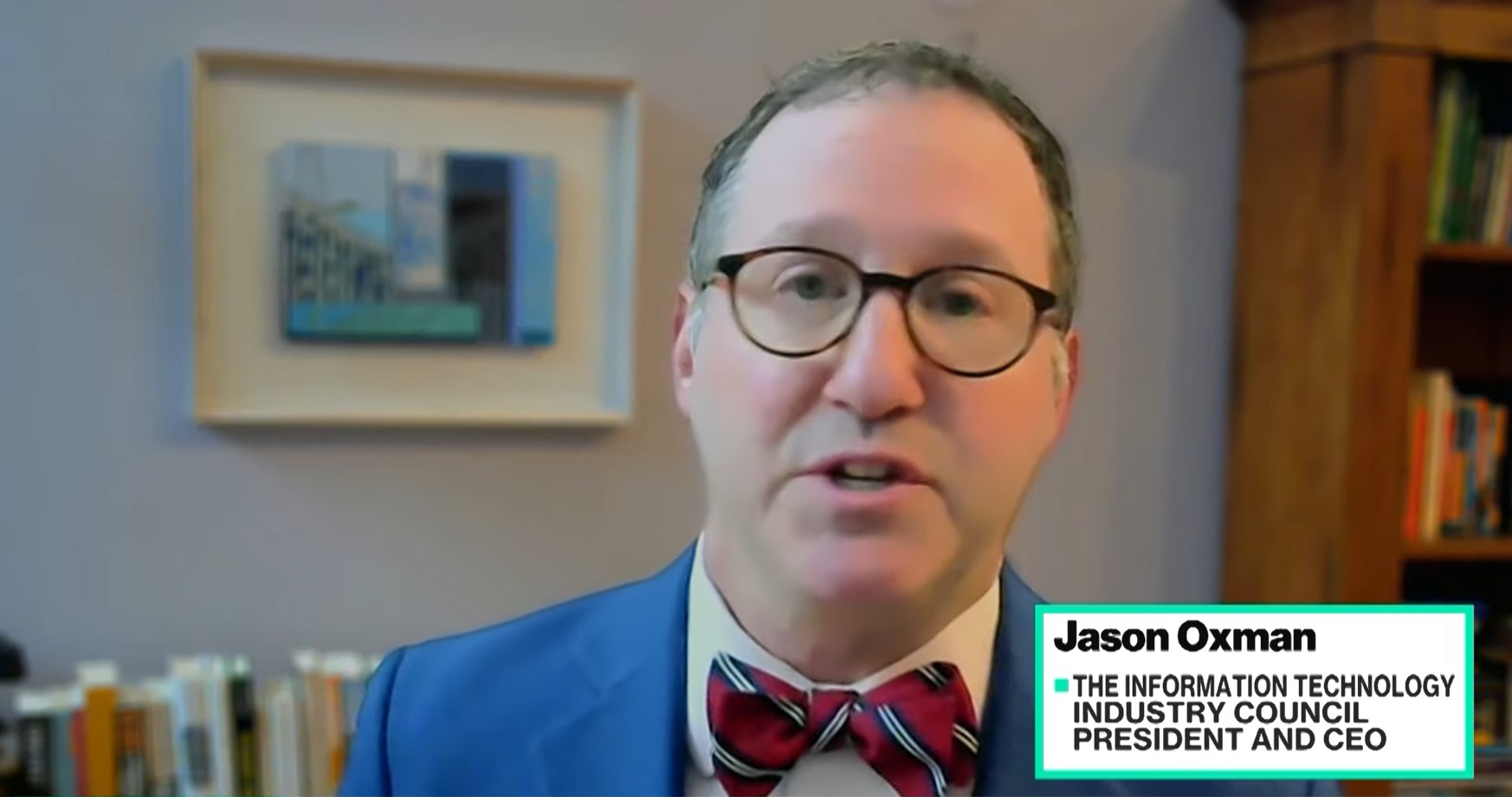
The head of the Information Technology Industry Council (ITI) is calling for sweeping regulatory reforms to support the rapid expansion of artificial intelligence infrastructure, warning that the United States must streamline energy permitting and unify fractured state regulations to maintain its global technological edge.
In an interview with Bloomberg Technology on Tuesday, Jason Oxman, President and CEO of ITI, outlined the industry’s roadmap for 2026, emphasizing the critical need to address power supply constraints caused by the booming data center sector.
“Policymakers are paying a lot of attention to this issue and the demand created by the construction of new data centers demands new access to energy sources,” Oxman told Bloomberg’s Caroline Hyde. He noted that the U.S. has suffered from “underinvestment in the energy grid” over the last few decades.
To combat delays in grid modernization, the tech industry is throwing its weight behind the SPEED Act, legislation recently moved through the House, designed to accelerate infrastructure projects.
“The SPEED Act would invoke regulatory reforms to speed up the permitting process for construction of new energy projects,” Oxman said. “It takes years and years to put new energy on the grid… the one piece that Washington is trying to address is reducing the regulatory burden to make sure we can make those investments that we need to make.”
The Economic Trade-off
While acknowledging consumer concerns regarding potential increases in power bills due to the energy appetite of AI data centers, Oxman argued that the macroeconomic benefits outweigh the costs. He cited a recent Vanguard report highlighting the disparity in economic outcomes between AI-integrated sectors and the broader market.
“Job growth in AI-affected industries is 1.7%… job growth in non-AI-affected industries is 0.8%,” Oxman said. He added that the wage gap is even more pronounced: “Wage growth in AI-related industries was 3.8% versus 0.7% in non-AI-related industries.”
Oxman emphasized that data centers are merely the vessels for broader economic acceleration. “It’s what the data centers do,” he said. “They are buildings that contain the future of technology for the country.”
Geopolitics and Export Controls
The interview also touched on reports of potential semiconductor diversion to China, specifically regarding Nvidia chips. While Oxman stated there was “no actual evidence” of wrongdoing by Nvidia in a recent investigation involving a Singapore-based client, he used the opportunity to critique restrictive export policies.
Oxman characterized the previous administration’s strategy of broad export bans as counterproductive to national security.
“The Biden administration took a very clear approach to this, which I think was the wrong approach… and that was to cut off access to the world to US technology,” Oxman stated.
He argued that broadly denying China access to American technology incentivizes them to develop autarkic systems that rival the U.S. “This is a race against China,” Oxman said. “Denying US companies the access to the global market is the wrong approach.”
Federal Preemption of State Laws
Looking ahead to 2026, the ITI chief identified the fragmentation of AI regulation as a primary hurdle. With over 100 AI-related laws adopted at the state level in 2025 and roughly 1,000 bills pending, the industry is seeking federal intervention to prevent a regulatory patchwork.
Oxman signaled strong support for recent executive actions taken by the Trump administration aimed at centralizing oversight.
“President Trump just signed an executive order… tasking the administration with proposing legislation to Congress that will replace those 50 potential separate regimes with one federal regime,” Oxman said.
He concluded that for the sector to thrive, consistency is paramount. “Technology is best deployed not with 50 different regulatory regimes applicable, but one common regime,” he said.