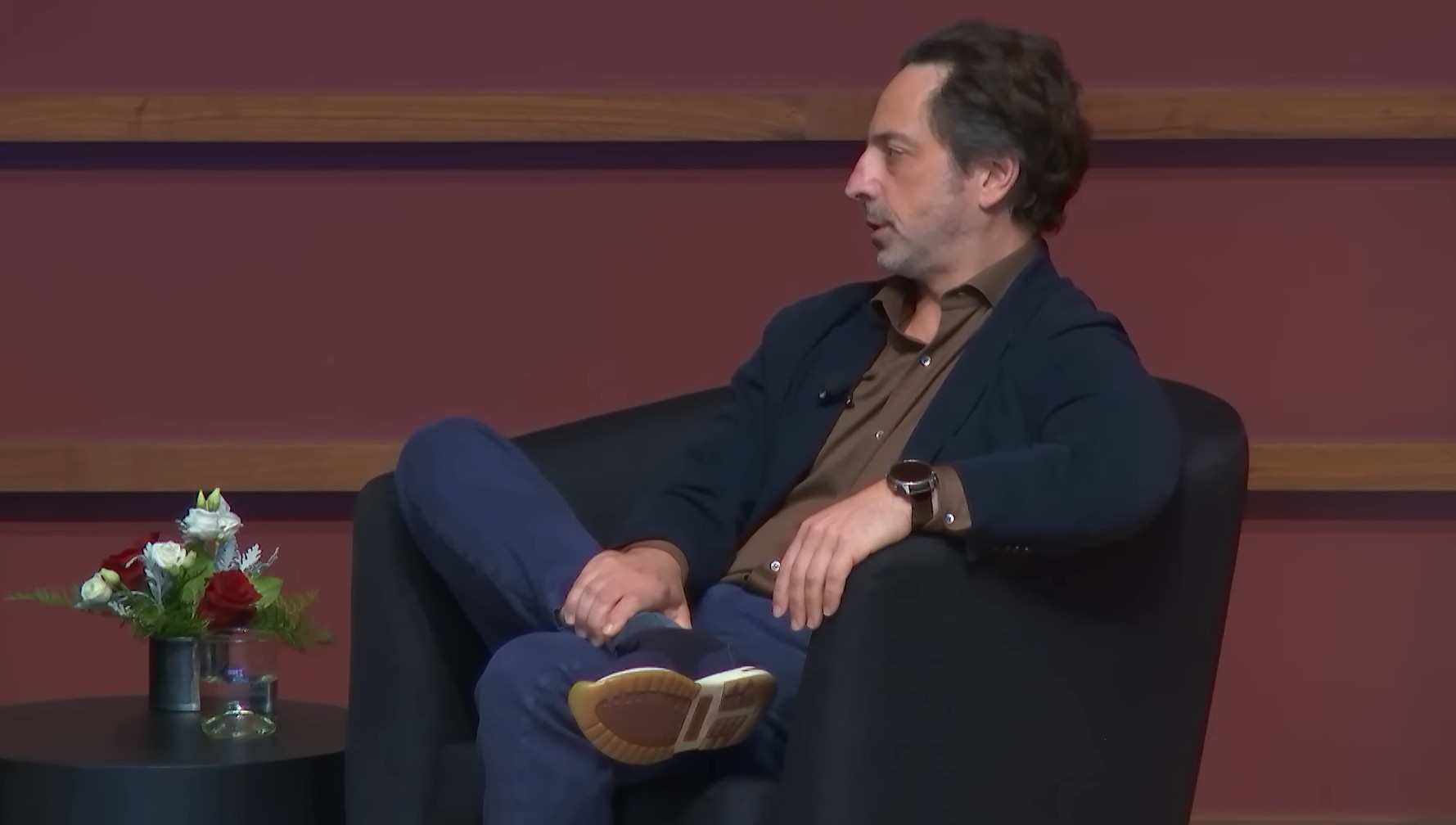
Sergey Brin, the co-founder of Google and the world’s eighth-richest person, returned to his alma mater this month to close out the Stanford School of Engineering’s centennial year. In a candid conversation that ranged from the whimsical origins of the search giant to the existential race for artificial intelligence, Brin offered a rare glimpse into his return to active duty at the company he started in a dorm room nearly 30 years ago.
Speaking at the “Big Ideas Begin Here” event hosted by the Stanford School of Engineering, Brin joined Stanford President Jonathan Levin and Dean of Engineering Jennifer Widom to reflect on a century of innovation and the next frontier of technology.
While the event celebrated the history of the school—highlighted by the presence on stage of the original server that ran the first iteration of the PageRank algorithm—the conversation was dominated by the rapid evolution of generative AI. Brin, who stepped back from day-to-day operations at Alphabet Inc. in 2019, revealed that the allure of the AI boom was too strong to resist, prompting his return to hands-on work.
“I actually retired like a month before COVID hit… and it was like the worst decision,” Brin told the audience of students and faculty. “I had this vision that I was going to sit in cafes and study physics, which was my passion at the time… that didn’t work because there were no more cafes.”
Brin described a feeling of intellectual stagnation during his time away, which ultimately drove him back to the Googleplex to work on the company’s AI models, including Gemini. “I felt myself spiraling, kind of not being sharp,” he admitted. “To be able to have that technical creative outlet, I think that’s very rewarding.”
On the AI Race and Missed Opportunities
The discussion, moderated by President Levin—who was a classmate of Brin’s at Stanford in the early 1990s—did not shy away from Google’s position in the current competitive landscape. While Google researchers authored the seminal “Transformer” paper that underpins modern large language models, the company is often perceived as having been slower to productize the technology compared to rivals like OpenAI.
Brin acknowledged that despite having the technical foundation, the company did not fully anticipate the speed at which the technology would scale.
“We actually didn’t take it all that seriously and didn’t necessarily invest in scaling the compute,” Brin said, referring to the period following the initial research breakthroughs. “But we also at the time had developed the chips for it… the TPUs go back 12 years.”
However, Brin argued that the industry is currently witnessing a unique moment where algorithmic breakthroughs are outpacing hardware advancements. “If you carefully line things up, you will see that actually the algorithmic progress has outpaced even the scaling over the last decade or something,” he noted.
From Pizza Faxes to Trillion-Dollar Algorithms
The event served as a homecoming for Brin, who dropped out of Stanford’s Ph.D. program to found Google with Larry Page. He recalled the mid-90s at Stanford as a “very creative and free time,” characterized by experimentation that didn’t always lead to success.
Brin recounted an early, failed entrepreneurial effort involving a website for ordering pizza via fax machine. “It seemed crazy at the time that you could order food online,” Brin laughed. “I realized they don’t actually check their faxes very often… and it flopped from there.”
He contrasted that era with the current environment for students, noting that while the technology has changed, the value of deep technical understanding remains. When asked by a student if studying computer science was still viable given AI’s ability to write code, Brin remained a staunch advocate for the discipline.
“I wouldn’t not choose computer science just because AI can be decent at coding nowadays,” Brin said. He emphasized that while AI handles routine tasks, the ability to understand and architect complex systems remains vital. “I do think it has a huge potential to improve individual capability.”
The Future of Innovation
Looking forward, Brin expressed optimism about the application of AI beyond chatbots and search, particularly in scientific fields. He pointed to material science and biology as areas ripe for disruption.
“I think there are still some things that do take the decade of kind of more pure research,” Brin said, suggesting that while the timeline from idea to commercialization has compressed, fundamental science still requires patience.
As the session concluded, Brin offered a piece of advice to the aspiring entrepreneurs in the room, seemingly derived from his own trajectory from a Stanford grad student to a tech titan navigating a new era of disruption.
“Make sure you’ve baked your idea long enough and developed it sort of long enough to a far enough point,” Brin advised, warning against the pressure to launch prematurely. “You get this snowball of expectations that happens, and you don’t give yourself all the time that you need to process them.”