As Russia prepares for its biggest holiday of the year, the country’s newspapers present a stark dichotomy: a front page of festive traditions and stable salad prices, shadowed by inside pages warning of soaring inflation and a crippling workforce deficit.
In a press review broadcast on December 24, 2025, the BBC’s Russia Editor Steve Rosenberg analyzes how the domestic media is covering the transition into a challenging new year. While Komsomolskaya Pravda showcases the 26-meter New Year tree at the Kremlin and “Grandfather Frosts” preparing for celebrations, the economic forecast for 2026 appears far less jubilant.
The Calm Before the Storm
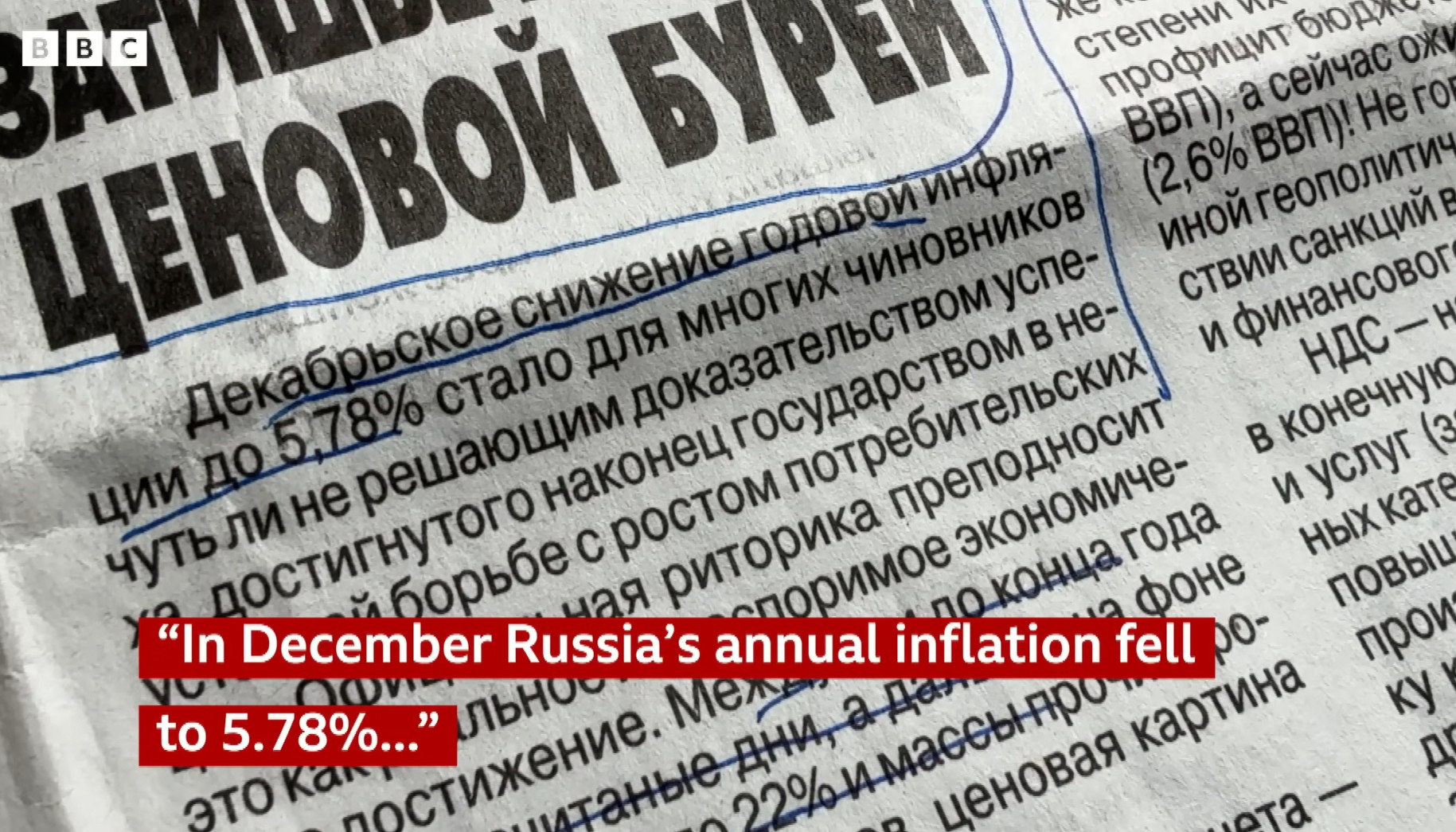
The papers initially offer some holiday reprieve regarding the cost of living. Komsomolskaya Pravda reports that the cost of preparing an Olivier salad—a dish synonymous with Russian New Year celebrations featuring potatoes, mayonnaise, and sausage—is “only 2.3% more than last year.” Furthermore, Moskovsky Komsomolets notes that annual inflation in December dipped to 5.78%.
However, the same paper characterizes this current stability as “the calm before the price storm.” With the Value Added Tax (VAT) scheduled to rise to 22% immediately after the holidays, the publication predicts the tax hike will spark “a chain reaction.”
The paper warns of “an inflationary spiral” in which the costs of “food, utilities, transport, core services all go up in price together, creating the effect of long-term pressure across the board on people’s wallets.”
“Constructive Destruction” and Labor Shortages
Beyond inflation, the Russian press highlights systemic economic issues. Nezavisimaya Gazeta reports on an acute personnel crisis, declaring that “the economy doesn’t have enough workers, machine operators, assembly workers.” The paper estimates that the country needs to find “800,000 blue-collar workers from somewhere,” warning that without them, sectors like manufacturing and agriculture face “risks to their stability and development.”
The strain is also evident in the hospitality sector. Kommersant reports that “the number of catering establishments in Russia is falling,” dropping by 3.1% over the last year as businesses struggle with rent and food costs.
Economists cited in the press offer grim solutions for 2026. One expert suggests to readers that “what’s needed is a period of ‘constructive destruction’,” implying a wave of bankruptcies is necessary to clear the way for future growth. Another warns of “negative growth”—a phrase Rosenberg notes is likely “meant to sound less painful than ‘fall’ or ‘drop’.”
Geopolitical Optimism regarding the U.S.
While the economic outlook is volatile, the political narrative regarding the United States remains optimistic in the wake of the political shifts in Washington. The papers continue to speak favorably of Donald Trump while casting Europe and Ukraine as the primary antagonists.
Kommersant concludes that “the US has de facto pulled out of the anti-Russian coalition.” Meanwhile, Arguments and Facts alleges that “European and Ukrainian hawks are trying their hardest to destroy Trump’s peace initiatives.”
Amidst the heavy geopolitical and economic analysis, the papers still find space for lighter fare. As Rosenberg highlights, one paper features a guide on how cats meow in different languages, offering a brief moment of levity before a year that the Russian press predicts will be economically turbulent.