As the United States signals a profound strategic pivot away from its traditional role as the primary security anchor for the continent, European leaders are facing a stark reality: higher defense budgets alone may not be enough to secure their borders.
A comprehensive new report released by the Center for Strategic and International Studies (CSIS), titled How Europe Can Defend Itself with Less America, argues that the Transatlantic relationship is entering a volatile new era defined by a move “from burden sharing to burden shifting.”
Max Bergmann, Director of the Europe, Russia, and Eurasia Program at CSIS, outlined the precarious position Europe faces as Washington reevaluates its global force posture. According to Bergmann, the Biden administration’s push for allies to spend more was only the beginning. The prevailing sentiment in Washington, he notes, is that the U.S. “can’t have the expectation of being [Europe’s] permanent guarantor.”
The “Burden Shifting” Reality
While European nations have announced significant increases in defense spending—reaching 3.5% to 5% of GDP in some cases following recent NATO summits—the CSIS report warns that these figures “mask a broader challenge.”
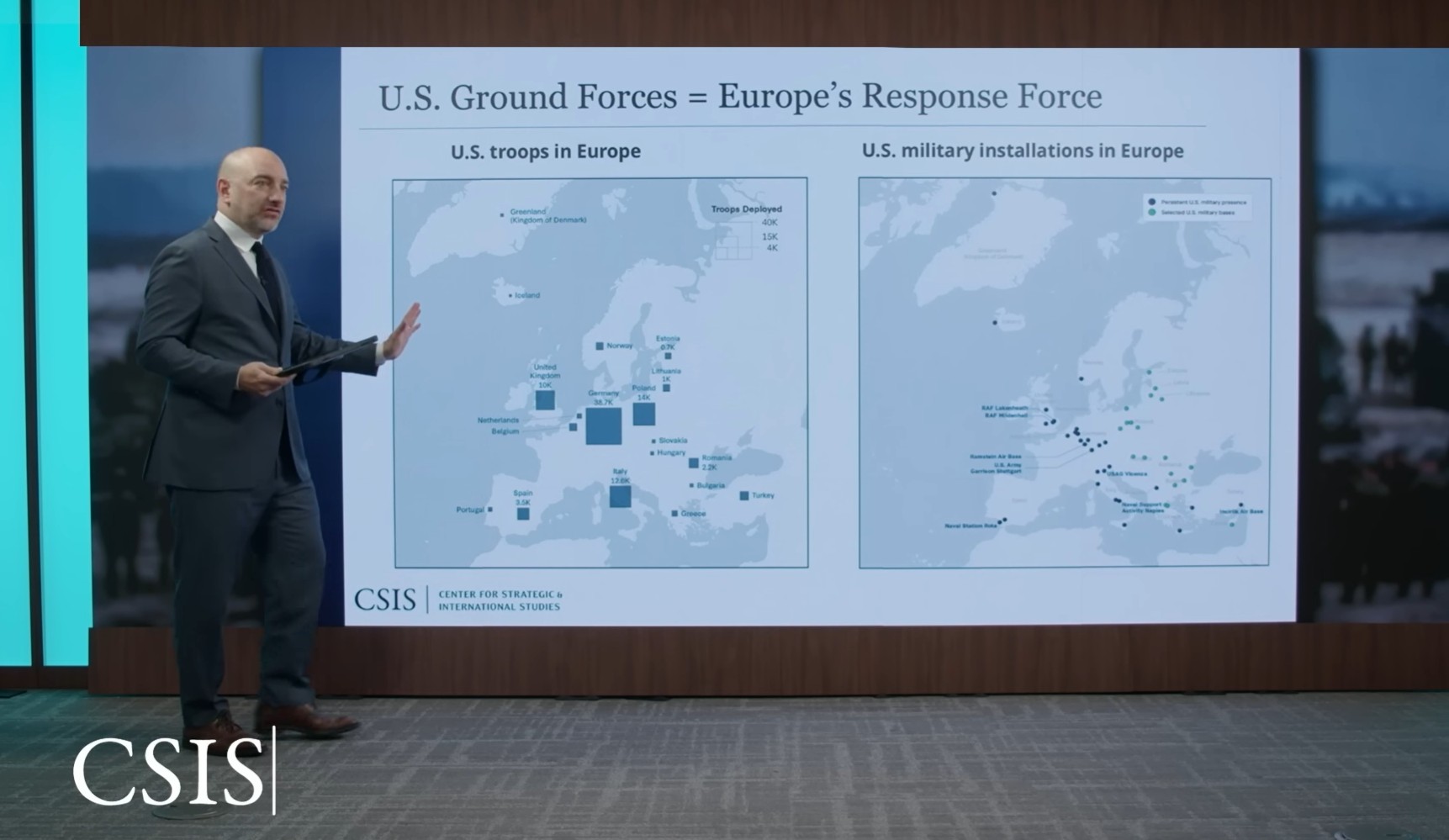
The core issue, Bergmann argues, is not just money, but capabilities and force structure. Currently, American ground forces stationed in Germany and Poland serve effectively as “Europe’s response force.” If Russia were to cross a NATO border in the Baltics, it is American troops who are positioned to react immediately.
A significant U.S. drawdown would leave a security vacuum that European militaries are currently ill-equipped to fill. The report identifies critical gaps in “enablers”—essential support systems such as air-to-air refueling tankers, strategic air transport, and satellite communications—where Europe remains almost entirely dependent on American assets to conduct operations.
“Europe’s focus on spending has masked deeper defense vulnerabilities,” Bergmann stated.
A Radical Proposal: A Pan-European Army
To mitigate the risks of an American withdrawal, the report proposes a series of ambitious, structural overhauls for European defense. The most significant recommendation is the creation of a permanently deployed “pan-European force” comprising roughly 100,000 troops.
Bergmann suggests that Europe utilizes its “collective scale and capacity” to build this force, noting that nations like Spain and Italy maintain large standing armies—122,000 and 160,000 troops respectively—that are often stationed far from the eastern flank.
“If the United States is not acting as Europe’s rapid reaction force, Europe may need to create a rapid reaction force,” Bergmann said, suggesting that a centralized force could be funded through EU mechanisms while utilizing troops from member states.
The Fragmentation Problem
The report also highlights the logistical nightmare caused by equipment fragmentation. While NATO equipment is interoperable, it is rarely interchangeable. Distinct national variants of tanks and aircraft create a “maintenance and logistical challenge” that would be debilitating in a high-intensity conflict.
To solve this, CSIS researchers argue for the establishment of a new European procurement authority and the issuance of defense-focused “Eurobonds.” Bergmann drew a parallel to the COVID-19 pandemic, where the EU broke precedent to borrow jointly for economic recovery. “If you could borrow jointly in response to COVID… you can borrow in response to war,” he argued.
A “Draghi-Style” Moment for Defense
The report concludes that the current piecemeal approach to bolstering NATO’s eastern flank is insufficient if the U.S. umbrella folds. Bergmann calls for a “Draghi-style report for European defense”—referencing the landmark economic competitiveness report by former Italian Prime Minister Mario Draghi—to fundamentally rethink how the continent protects itself.
With the potential for reduced U.S. involvement looming, the report suggests that the time for incremental change has passed.
“It needs to start thinking,” Bergmann concluded, “about how Europe can defend itself with less America.”