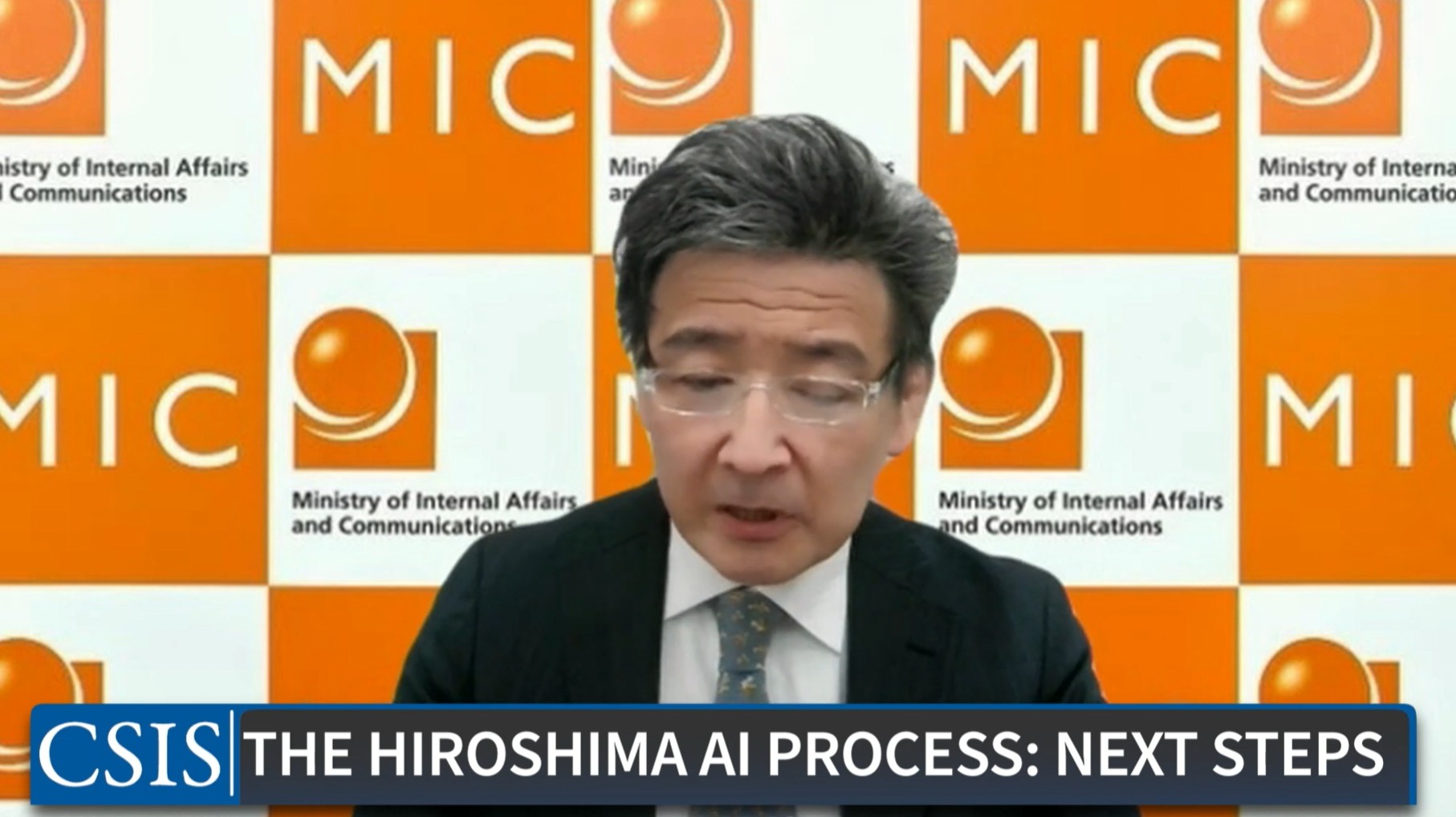
In the race to regulate artificial intelligence without stifling innovation, Japan is urging the international community to move from high-level principles to concrete monitoring and implementation.
During a discussion hosted by the Center for Strategic and International Studies (CSIS) released on April 15, Yoichi Iida, Assistant Vice Minister for International Affairs at Japan’s Ministry of Internal Affairs and Communications, detailed the trajectory of the “Hiroshima AI Process.” Launched during Japan’s G7 presidency in 2023, the initiative has become a cornerstone of global efforts to manage the risks of generative AI.
Iida, a central figure in international tech diplomacy who chaired the G7 working group on digital policy, emphasized that while different nations are adopting different regulatory styles—ranging from the European Union’s binding “AI Act” to the “soft law” approaches favored by the U.S. and Japan—the primary goal remains preventing a fractured global landscape.
“We didn’t want to see the fragmentation of the governance frameworks and approaches even in this small group of G7,” Iida told Gregory C. Allen, director of the Wadhwani Center for AI and Advanced Technologies at CSIS. “We need to promote the coherence and interoperability between different frameworks.”
Adapting to the Generative AI Boom
While international discussions on AI governance began years ago, the release of ChatGPT in late 2022 fundamentally altered the diplomatic timeline. Iida noted that the sudden public availability of powerful generative models shocked policymakers and the public alike.
“People around the world were surprised to see the performance of ChatGPT and many of them were frightened,” Iida said. He explained that this urgency drove the G7 leaders to establish the Hiroshima AI Process, intending to “put some guardrails around this technology so that people can reap the benefits of this technology without concern.”
The result was a comprehensive Code of Conduct for organizations developing advanced AI systems, agreed upon by G7 leaders late last year. However, Iida stressed that these documents are not static.
“You will find the wording of ‘living document,’” Iida said, referring to the guidelines. “We know there should be more to be done to make these instruments workable and effective to respond to the emerging situations.”
The Role of the OECD and Future Monitoring
As Italy takes over the G7 presidency for 2024, the focus is shifting toward monitoring compliance and expanding the circle of participants. Iida highlighted the Organization for Economic Cooperation and Development (OECD) as a critical “knowledge partner” in this phase.
Unlike the rotating presidencies of the G7 or G20, the OECD possesses a permanent secretariat with deep technical expertise. Iida confirmed that the OECD is currently working to update its own AI principles, originally endorsed in 2019, and is establishing mechanisms to track how companies and nations are adhering to the new Code of Conduct.
“We are expecting to finalize the work to update and review the AI principles by OECD to be endorsed by ministers,” Iida noted, pointing toward the OECD Ministerial Council Meeting scheduled for May, which Japan will chair.
Expanding Beyond the West
A recurring theme in Iida’s remarks was the necessity of inclusivity. For AI governance to be effective, it cannot be the sole domain of wealthy Western democracies. Iida pointed to the Global Partnership on AI (GPAI) as a vital forum for engaging with the Global South, specifically highlighting India’s role.
“We need to reach out beyond G7,” Iida stated, noting that developing nations have distinct histories and economic requirements that must be respected. He praised India as “such an active country in particular in digital and AI policymaking,” expressing hope that New Delhi would be a “very important partner in this framework.”
Next Steps under Italian Leadership
The G7’s work on AI shows no sign of slowing down. In an unusual move, the Italian presidency has scheduled multiple ministerial meetings on digital technology this year, a decision Iida interpreted as a sign of the topic’s urgency.
The immediate goal is to operationalize the Hiroshima Process’s outcomes through a reporting mechanism where companies voluntarily disclose how they are handling risks such as disinformation and copyright infringement.
“We are trying to show these two very important instruments are a kind of set,” Iida said, referring to the guiding principles and the code of conduct. The objective is to create a system where nations can maintain their domestic regulatory preferences while still adhering to a shared international standard of safety and trustworthiness.
“Different sectors have different existing regulatory frameworks,” Iida concluded, “but they may find the additional element… to be added in responding to the new situation.”