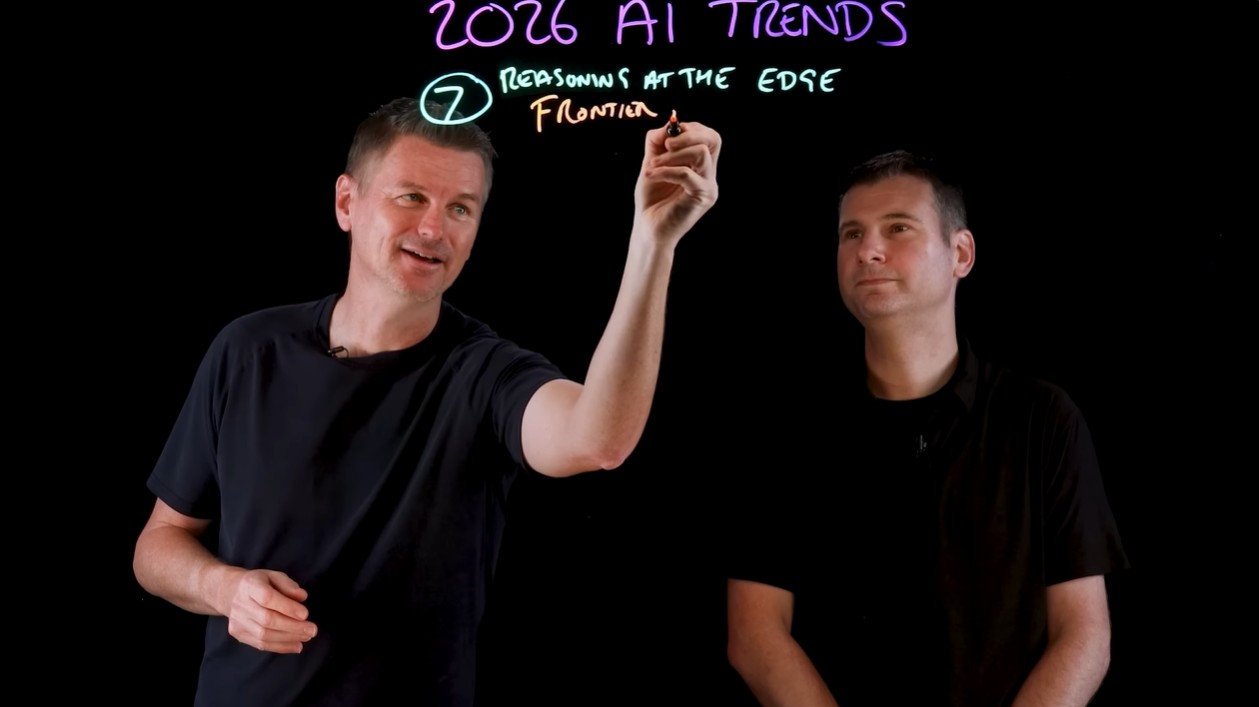
As the artificial intelligence landscape shifts from experimental chat interfaces to integrated enterprise solutions, experts at IBM are projecting a fundamental transformation in how AI interacts with the physical world and computing infrastructure by 2026.
In a newly released forecast by IBM Technology, Martin Keen, a Master Inventor at IBM, and IBM Fellow Aaron Baughman outlined eight pivotal trends anticipated to define the technological ecosystem two years from now. The predictions suggest a move away from standalone generative text models toward orchestrated agent teams, physical robotics, and verifiable governance.
From Single Agents to Orchestrated Workforces
While 2025 was characterized as the year of the individual AI agent, 2026 is expected to be defined by “multi-agent orchestration.” Keen argues that because “no single agent really excels at everything,” the industry will pivot toward systems where specialized agents—planners, workers, and critics—collaborate under a central orchestrator. This approach allows for cross-checking and breaking down complex goals into verifiable steps.
Baughman expands this concept into what he terms a “digital labor workforce.” These autonomous agents will be capable of parsing multimodal inputs and executing workflows across downstream components. Crucially, this trend emphasizes a “human in the loop” architecture to provide oversight and strategic rails.
“This overall trend will create a force multiplying effect to extend human capability,” Baughman noted. He further predicted the rise of “social computing,” where agents and humans operate within a shared fabric, exchanging context and intent to create a “collective intelligence or this real-world swarm computing.”
AI Enters the Physical Realm
Perhaps the most significant shift predicted is the move from digital-only generation to “Physical AI.” While current Large Language Models (LLMs) generate text or pixels, the next generation of models will perceive and reason about the 3D world.
“Physical AI is about models that understand and interact with the world that we live in, the real 3D world,” Keen said.
This involves training “world foundation models” within simulations to understand physics—such as gravity and object manipulation—before deploying them into hardware. Keen observed that by 2026, manufacturers will be taking humanoid robots “from research to commercial production,” signaling that “Physical AI is scaling.”
The Era of Verifiable and Regulated AI
With the European Union’s AI Act set to become fully applicable by mid-2026, regulatory compliance will become a primary technical requirement. Keen compares the upcoming shift to the impact of GDPR on data privacy.
“The EU AI Act will probably set the template for AI governance worldwide,” Keen stated.
This trend, labeled “Verifiable AI,” necessitates that high-risk systems be auditable and traceable. Developers will be required to maintain rigorous documentation regarding testing and risk, ensure transparency regarding synthetic content, and provide clear data lineage to prove respect for copyright opt-outs.
Quantum Utility and Reasoning at the Edge
On the infrastructure front, IBM predicts that 2026 will mark the arrival of “Quantum utility everywhere.” Baughman suggests that hybrid systems combining quantum and classical computing will begin to solve optimization and simulation problems “better, faster, or more efficiently than classical computing methods.”
Simultaneously, the nature of AI processing is expected to diverge. While massive frontier models utilize “inference time compute” to “think” through problems step-by-step, engineers are finding ways to distill this reasoning capability into much smaller models.
“Teams have figured out how they can distill all of this reasoning information into smaller models,” Keen explained. This trend, “reasoning at the edge,” will allow devices with limited parameters to perform complex tasks offline, eliminating the latency of round-trips to data centers for mission-critical applications.
Amorphous Hybrid Computing
Finally, the report describes a future of “amorphous hybrid computing,” where the lines between different chip architectures blur. Baughman describes a unified environment where CPUs, GPUs, TPUs, and Quantum Processing Units (QPUs) work in concert.
This fluid computing backbone will support evolving model topologies that go beyond standard transformers, automatically mapping tasks to the most efficient hardware. “This is really going to help to deliver this maximum performance and efficiency,” Baughman concluded.