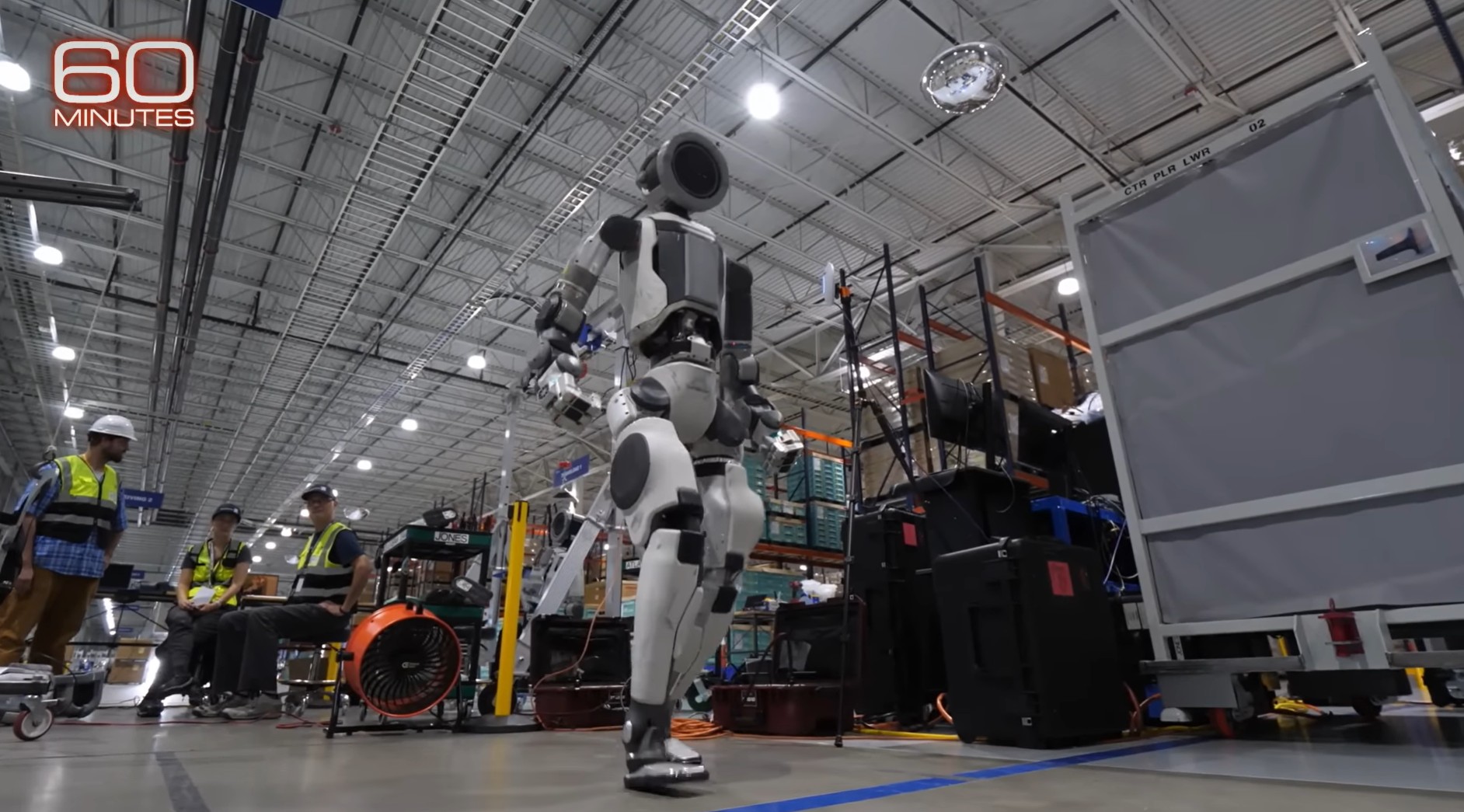
Deep inside a sprawling auto plant near Savannah, Georgia, the future of manual labor is stretching its legs. In a back corner of the Hyundai factory, far from the traditional robotic arms bolted to the assembly line, a machine named Atlas is learning to move parts. It stands 5-foot-9, weighs 200 pounds, and walks on two legs. The robot has left the laboratory.
For years, Boston Dynamics captivated the internet with viral videos of hydraulic robots performing backflips and parkour. But according to a new report from 60 Minutes, the company has pivoted from internet stunts to industrial grinding. The new Atlas is fully electric, powered by advanced Nvidia microchips, and designed for the mundane, repetitive tasks of the factory floor.
This transition marks a fundamental shift in robotics. Previous generations of machines followed rigid code written by engineers. The new Atlas uses artificial intelligence to learn from experience.
Learning Through Failure
Scott Kuindersma, head of robotics research at the Massachusetts-based company, demonstrated the process by wearing a motion-capture suit. As he performed jumping jacks or sorted automotive parts, the robot’s software digitized the movements. The system then ran thousands of simulations, forcing digital avatars to practice the task under varying conditions—slippery floors, stiff joints, or heavy loads—until the AI mastered the skill.
“We love when things like this happen actually.”
— Scott Kuindersma, head of robotics research at Boston Dynamics, after the robot attempted a “duck walk” during a demo and collapsed in a heap of plastic and metal
Failures generate data. The robot is learning to understand the physical world. By using tele-operators—humans wearing VR headsets who guide the robot’s hands—the system captures the nuances of dexterity. Once one robot learns a task, the knowledge is uploaded instantly to the entire fleet.
Context
Hyundai holds an 88% stake in Boston Dynamics. The company’s new Georgia factory serves as a testing ground for integrating bipedal machines into a workforce of humans and traditional automation.
The Global Race
$38B
Projected humanoid robot market within a decade — Goldman Sachs
A global race is underway, with competitors like Tesla and state-supported Chinese firms vying to solve the engineering puzzle of mass-producible, general-purpose robots.
“The Chinese government has a mission to win the robotics race.”
— Robert Playter, CEO of Boston Dynamics
Playter believes the U.S. currently holds a technical lead but faces a threat from the sheer scale of investment overseas.
Superhuman Workers
The arrival of autonomous, bipedal workers inevitably triggers economic anxiety. Playter dismissed the idea of a hostile machine takeover but acknowledged that the nature of labor is shifting. He envisions machines handling dangerous, back-breaking tasks, operating with strength and endurance no person could match.
“You really want superhuman capabilities.”
— Robert Playter, CEO of Boston Dynamics
This optimization sounds efficient to shareholders and terrifying to assembly line workers.
Full integration remains years away. While Atlas can manipulate heavy automotive parts, it still lacks the dexterity to perform simple human tasks like dressing itself or handling fragile objects. Yet, as the robot stands in the Georgia warehouse scanning its environment, it represents a turning point where science fiction dissolves into logistics.
“We are on track. It is a start of a great journey.”
— Hung Soo Kim, Hyundai’s head of global strategy