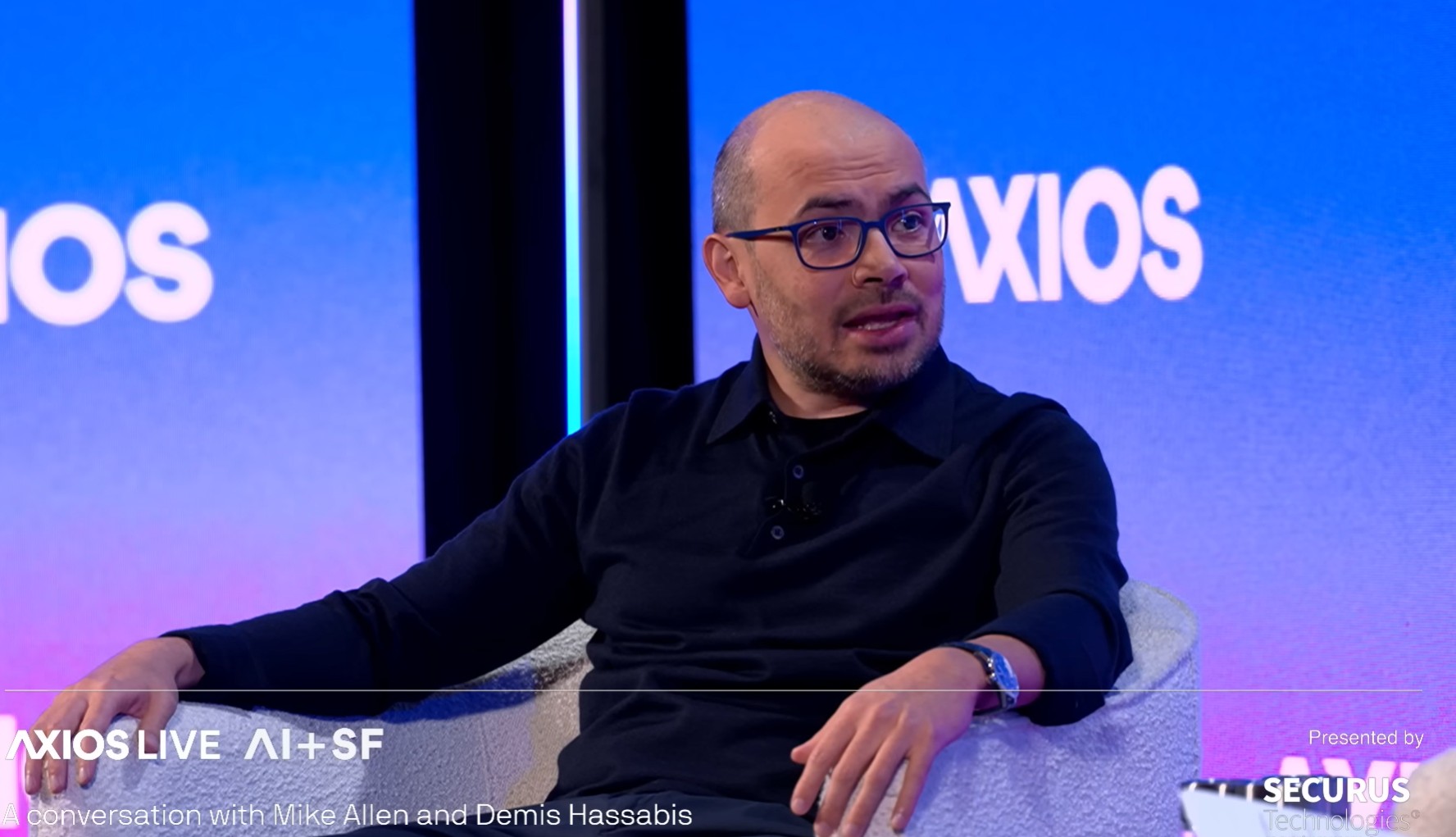
In a sweeping conversation at the Axios AI+ Summit, Google DeepMind co-founder and CEO Demis Hassabis offered a concrete timeline for the arrival of Artificial General Intelligence (AGI), predicting that human-level cognitive systems are likely “5 to 10 years away.”
Speaking with Axios co-founder Mike Allen just over a year after receiving a knighthood and weeks after becoming a Nobel Laureate, Hassabis outlined a future of “radical abundance” driven by AI, while simultaneously acknowledging a “non-zero” risk of catastrophic outcomes if the technology is not shepherded responsibly.
The Path to AGI
Hassabis, a neuroscientist and chess prodigy who has led Google’s AI efforts to the forefront of the industry, defined AGI as a system that exhibits all human cognitive capabilities, including creativity and invention. While acknowledging the power of current Large Language Models (LLMs), he described them as “jagged intelligences”—systems that possess “PhD-level skills” in some domains while remaining “very flawed” in others.
To bridge the gap to AGI, Hassabis suggested that simply scaling current models might not be enough.
“I suspect when we look back, once AGI is done, that one or two… transformer-level or AlphaGo-level type of breakthroughs were still required in addition to scaling,” Hassabis said. He noted that achieving AGI will require solving issues related to memory, planning, and reasoning.
The Next 12 Months: Agents and World Models
Looking at the immediate future, Hassabis highlighted the convergence of modalities—text, image, audio, and video—as a primary driver of progress. He pointed to the development of “world models” and “agent-based systems” as the next frontier.
He teased DeepMind’s work on “Genie 3,” an interactive video model that allows users to generate a video and then interact with it “like you’re in a game or simulation.” Furthermore, he predicted that within a year, we will see significant progress in AI agents—systems capable of executing complex, multi-step tasks.
“I think a year from now we’ll start having agents that are close to doing that,” Hassabis said, describing a vision for a “universal assistant” that becomes part of the “fabric of your life.”
Geopolitics and the AI Race
When pressed on the competitive landscape between the United States and China, Hassabis maintained that the West currently holds the advantage, though the margin is slim.
“I think the US and the West [are] in the lead,” Hassabis said, attributing this edge to algorithmic innovation rather than just hardware availability. However, he warned against complacency, noting that Chinese researchers are fast followers. “They’re not far behind… maybe the lead is only a matter of months as opposed to years at this point.”
Radical Abundance vs. Catastrophic Risk
Hassabis painted a polarized picture of the long-term impact of AI. On the upside, he envisions a “post-scarcity era” where AI helps solve humanity’s hardest problems, such as clean energy fusion and curing diseases.
“We’re potentially… [seeing] humanity flourishing and traveling to the stars and spreading consciousness to the galaxy,” he said.
However, he did not shy away from the existential risks, categorized primarily as bad actors repurposing the tech for harm (such as bioweapons or cyber terror) and the potential for an autonomous system to go “off the rails.”
When asked to quantify the probability of a catastrophic outcome—often referred to in the industry as “p(doom)”—Hassabis refused to give a percentage but was blunt about the danger.
“No one knows what it is,” Hassabis said. “What I know is, it’s non-zero. So clearly, if your p(doom) is non-zero, then you… must put significant resources and attention on that.”
The Scientific Method
Throughout the interview, Hassabis emphasized his identity as a “scientist first,” noting that the scientific method remains the “default approach I take to everything,” including business. He believes this rigorous, empirical approach gives DeepMind an edge in a field that is currently awash in venture capital and hype.
Regarding the current financial frenzy surrounding AI startups, Hassabis admitted that “some parts of the AI industry are probably in a bubble,” citing massive seed rounds for unproven companies. However, he distinguished the financial speculation from the technological reality.
“I think in the fullness of time,” Hassabis concluded, “this is all going to be more than justified.”