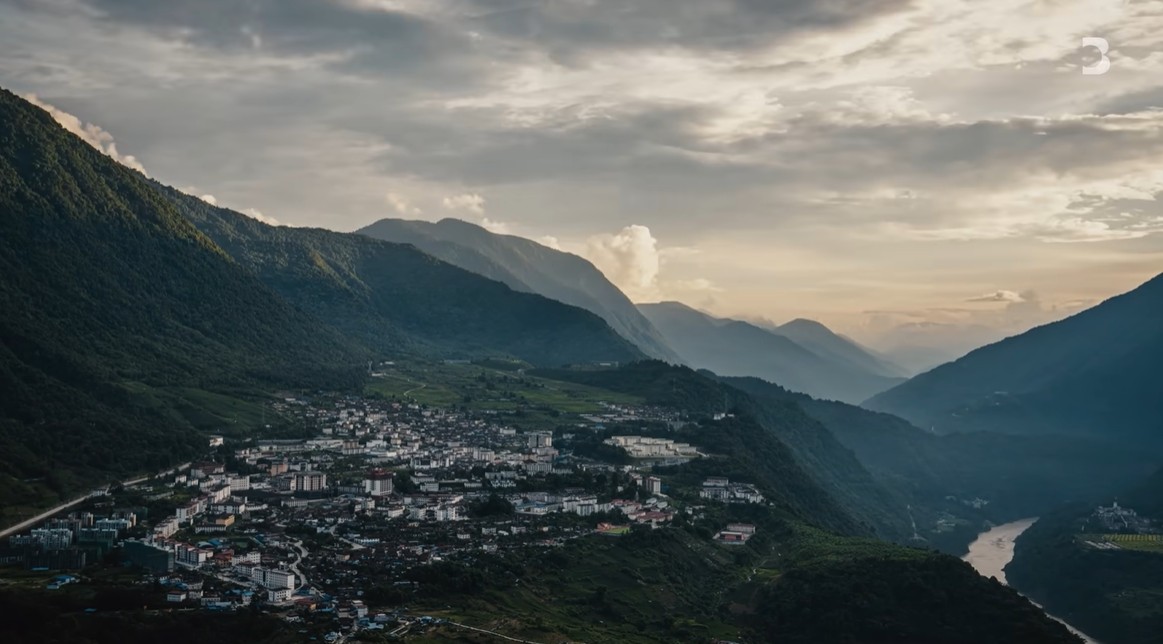
Deep within the Himalayas, where the Yarlung Tsangpo River makes a dramatic horseshoe turn known as the “Great Bend,” China has embarked on an infrastructure gamble that redefines the limits of modern engineering. Known as the Lower Yarlung Hydropower Project, or Yaxia, the initiative promises to generate three times the electricity of the Three Gorges Dam, yet it poses seismic and geopolitical risks that have put neighboring nations on high alert.
According to a new report by Bloomberg Originals, the project officially broke ground in July 2025. It is situated in one of the most remote and geologically unstable regions on Earth, a location Rafael Schmitt, an Assistant Professor of Environmental Studies at the University of California, Santa Barbara, calls “the project of the century.”
A “Mission to Mars” for Hydropower
The scale of the undertaking is unprecedented. The Three Gorges Dam, which has stood for decades as the symbol of China’s industrial might, generates enough electricity to power 70 million homes. The new project on the Yarlung Tsangpo is designed to dwarf that output.
“This is the most impressive power generation system ever envisioned,” said Brian Eyler, a Senior Fellow and Director at the Stimson Center, speaking to Bloomberg. “It’s the hydropower equivalent of a mission to Mars.”
The project aims to exploit a massive natural drop in elevation at the Great Bend, where the river falls approximately 2,000 meters over a 200-kilometer stretch. Rather than a single massive wall, the design involves a complex diversion system. Engineers plan to tunnel through the mountains, diverting the river’s flow through underground turbines before it re-enters the channel downstream.
Schmitt estimates the facility will boast “60 gigawatts of installed capacity.” The Chinese government has stated the project will generate 300 billion kilowatt-hours annually—more than the entire United Kingdom consumes in a year.
Economic Stimulus and Green Ambitions
The project comes with a staggering price tag of 1.2 trillion Yuan (approximately $167 billion), nearly five times the cost of the Three Gorges Dam. However, for Beijing, the dam serves a dual purpose: revitalizing a slowing economy and meeting aggressive climate goals.
“The dam, to some extent, is an extension of China’s bias towards production, towards investment,” said Chang Shu, Chief Asia Economist for Bloomberg Economics. She noted that the massive infrastructure spend could provide a “critical demand boost” for sectors like steel and cement.
Furthermore, the dam is a linchpin in President Xi Jinping’s goal to reach net-zero emissions by 2060. By replacing fossil fuel power, the project could eliminate 300 million tons of carbon emissions annually.
Playing with Tectonic Fire
Despite the economic and environmental promises, the project’s location is a source of alarm for geologists. The dam is being constructed on the edge of the Tibetan Plateau, a seismically active zone where the Indian and Eurasian plates collide.
“They are building this massive project on a site where six tectonic plates connect up,” warned Ruth Gamble, a Deputy Director at La Trobe University. She highlighted the immense physical dangers of construction in the area: “Landslides, freezing, malfunctioning equipment, people falling off the side of mountains.”
The region has a history of volatility; in 1950, it was the site of an 8.6 magnitude earthquake, one of the largest in recorded history. While Chinese engineers argue their technology can withstand these forces, experts warn that the sheer weight of the water and the tunneling could destabilize the region further.
The Water Wars
The geopolitical tremors may be as severe as the geological ones. The Yarlung Tsangpo flows from Tibet into India, where it becomes the Brahmaputra, and subsequently into Bangladesh. These downstream nations rely on the river for agriculture and fresh water.
There are deep fears in New Delhi that China could weaponize the water flow, holding it back during droughts or releasing it to cause floods during conflicts. The precedent set by China’s damming of the Mekong River has exacerbated these concerns. On the Mekong, unannounced water releases and retention by Chinese dams have disrupted the seasonal flood pulse essential for fishing and farming in Southeast Asia.
“Before dams, the water was normal but nowadays, the water levels have fluctuated more than usual,” said Somdet Singthong, a fisherman on the Mekong border of Thailand, describing the impact of upstream Chinese engineering. “It’s had a huge impact. It’s hard to make a living.”
China maintains that the project is scientifically sound and harmless. “China’s construction of the hydropower project in the Yarlung Tsangpo River downstream has gone through rigorous scientific verification,” said Guo Jiakun, a spokesperson for the Chinese Ministry of Foreign Affairs. He insisted the project “will not have any negative impact on the ecological environment, geology and water resources of the downstream countries.”
However, transparency remains a sticking point. China does not have water-sharing treaties with India, nor does it share real-time hydrological data. In response, India is reportedly fast-tracking its own hydropower projects on the Upper Siang to establish “prior use” rights and offset potential flow disruptions.
As China tunnels through the Himalayas, the Lower Yarlung project stands as a testament to the country’s engineering capability and its willingness to reshape the planet’s geography for energy security. But as Dan Murtaugh, a reporter for Bloomberg News, notes, the stakes are incredibly high.
“If China can pull this off, then it’s a statement to the rest of the world,” Murtaugh said. “We’re reshaping rivers. We’re creating clean energy. We’re providing our economy and companies with infinite clean energy that it can use to build the economy of the future.”