Nvidia has solidified its position as the undisputed king of the artificial intelligence era, becoming the first company in history to briefly breach a $5 trillion valuation in October 2025. However, a quiet revolution is brewing within the data centers of its biggest customers, as Big Tech giants race to deploy custom silicon designed to reduce their reliance on the chipmaker’s expensive hardware.
According to a new report by CNBC, while Nvidia’s graphics processing units (GPUs) remain the “gold standard” for training massive AI models, major cloud providers—including Amazon, Google, and Microsoft—are aggressively pivoting toward custom Application-Specific Integrated Circuits (ASICs) to handle the soaring demand for AI inference.
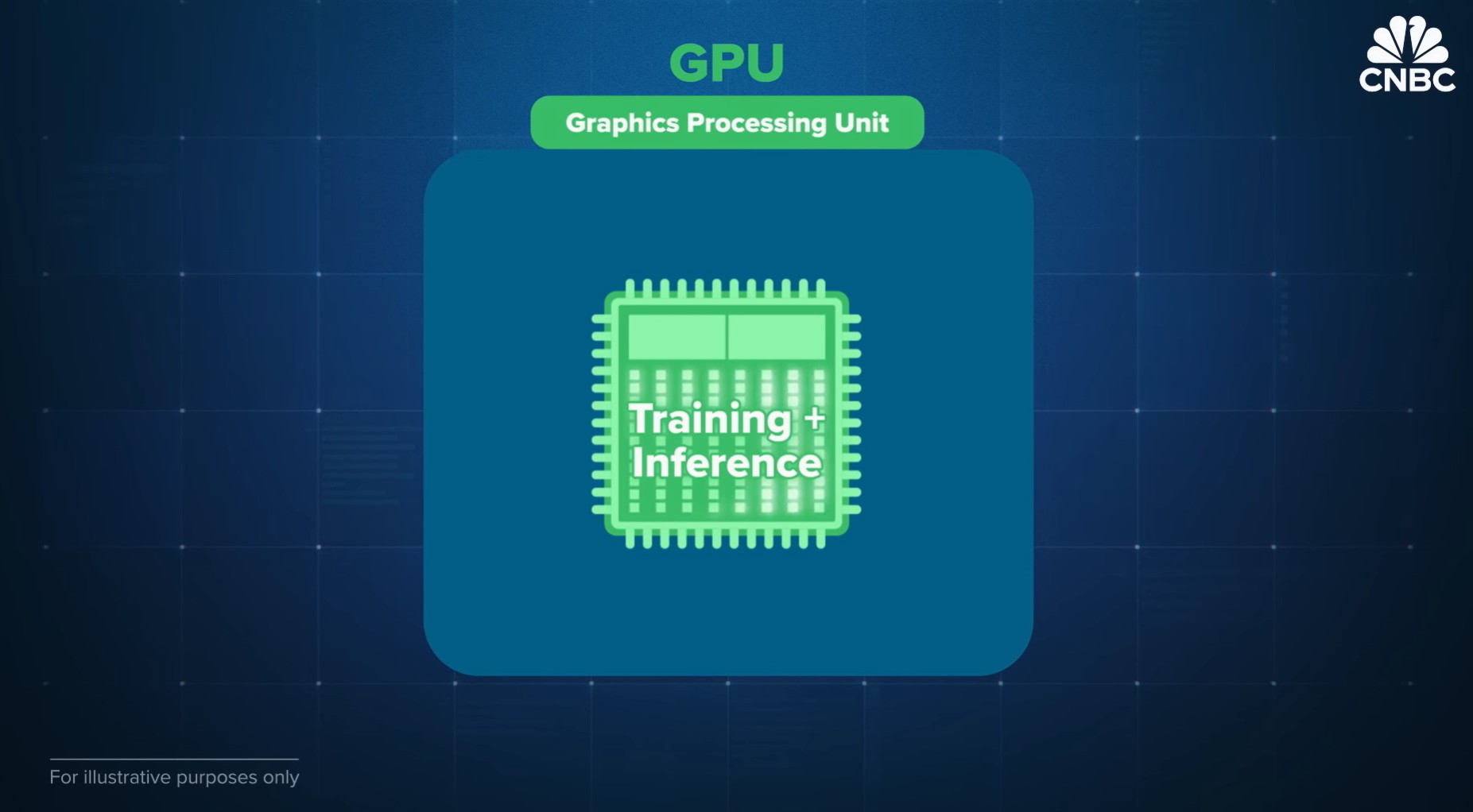
The shift marks a critical evolution in the semiconductor landscape. Nvidia’s rise was fueled by the parallel processing power of the GPU, a technology originally designed for gaming graphics that proved fortuitously perfect for the deep learning “big bang” of the last decade.
“A GPU in this case was really purpose-built to deliver parallel programming,” said Dion Harris, Nvidia’s senior director of AI infrastructure, in an interview with CNBC. “Because when you think about rendering an image or in a scene, you need to calculate all those pixels at once.”
That capability allowed Nvidia to corner the market on training AI models. However, as the industry matures from training models to running them—a process known as inference—efficiency is becoming the priority.
The Rise of the Custom ASIC
While a GPU operates like a “Swiss Army knife” capable of handling diverse and complex mathematical tasks, an ASIC is akin to a specialized tool designed for a singular purpose. For tech giants operating millions of servers, this specialization translates to massive cost and energy savings.
“They can be much, much more efficient in running those workloads,” Chris Miller, author of Chip War, told CNBC regarding ASICs. “But when you specialize them, you can’t change them once they’re already carved into silicon. And so there’s a trade-off in terms of flexibility.”
Despite the upfront costs of development, the economics are compelling for hyperscalers. Amazon Web Services (AWS), for instance, has invested heavily in its custom Trainium and Inferentia chips. Ron Diamant, head architect at AWS Annapurna Labs, noted that their custom silicon offers significant advantages over general-purpose hardware.
“On average, we see that Trainium provides between 30 and 40% better price performance compared to other hardware vendors,” Diamant said.
Google, a pioneer in this space, recently rolled out “Ironwood,” its seventh-generation Tensor Processing Unit (TPU). The search giant arguably led the custom chip revolution, having deployed TPUs internally since 2015.
The Broadcom Factor
The push for custom silicon has created a secondary boom for Broadcom, which acts as a critical partner for tech companies that lack the internal infrastructure to handle the entire physical design of a chip. Broadcom creates the custom chips for Google, Meta, and recently secured a deal with OpenAI.
According to Daniel Newman, CEO of The Futurum Group, Broadcom is positioned to dominate this specific niche. “We see Broadcom winning 70, maybe even 80% of this market,” Newman told CNBC, projecting a “mid-double-digit CAGR over the next five years.”
The Battle for the Edge
Beyond the data center, the chip war is moving to “edge” devices—smartphones, laptops, and cars—where privacy and latency are paramount. Companies like Apple, Qualcomm, and Intel are integrating Neural Processing Units (NPUs) directly into consumer devices to run AI locally rather than in the cloud.
“We know that when we can do things on device, we are able to manage people’s privacy in the best way,” said Tim Millet, Apple’s vice president of platform architecture. “The other thing about it is it is efficient for us, it is responsive. We know that we are much more in control over the experience.”
Supply Chains and Geopolitics
Regardless of whether the chip is a GPU from Nvidia or a custom ASIC from Amazon, the manufacturing bottleneck remains the same: Taiwan Semiconductor Manufacturing Company (TSMC).
The concentration of advanced manufacturing in Taiwan continues to drive U.S. policy efforts to onshore production. In a significant milestone for the CHIPS Act, Nvidia CEO Jensen Huang confirmed that the company has begun manufacturing its cutting-edge architecture on American soil.
“We are now manufacturing in full production Blackwell in Arizona,” Huang said.
As the AI infrastructure build-out continues, the market is diversifying. While Nvidia retains the performance crown for model training, the sheer scale of AI deployment is forcing the industry toward more specialized, efficient, and cost-effective solutions.
“They have that position because they’ve earned it and they’ve spent the years building it and they’ve won that developer ecosystem,” Newman said of Nvidia. “But that market’s going to get so big that we’re going to continue to see new entrants.”