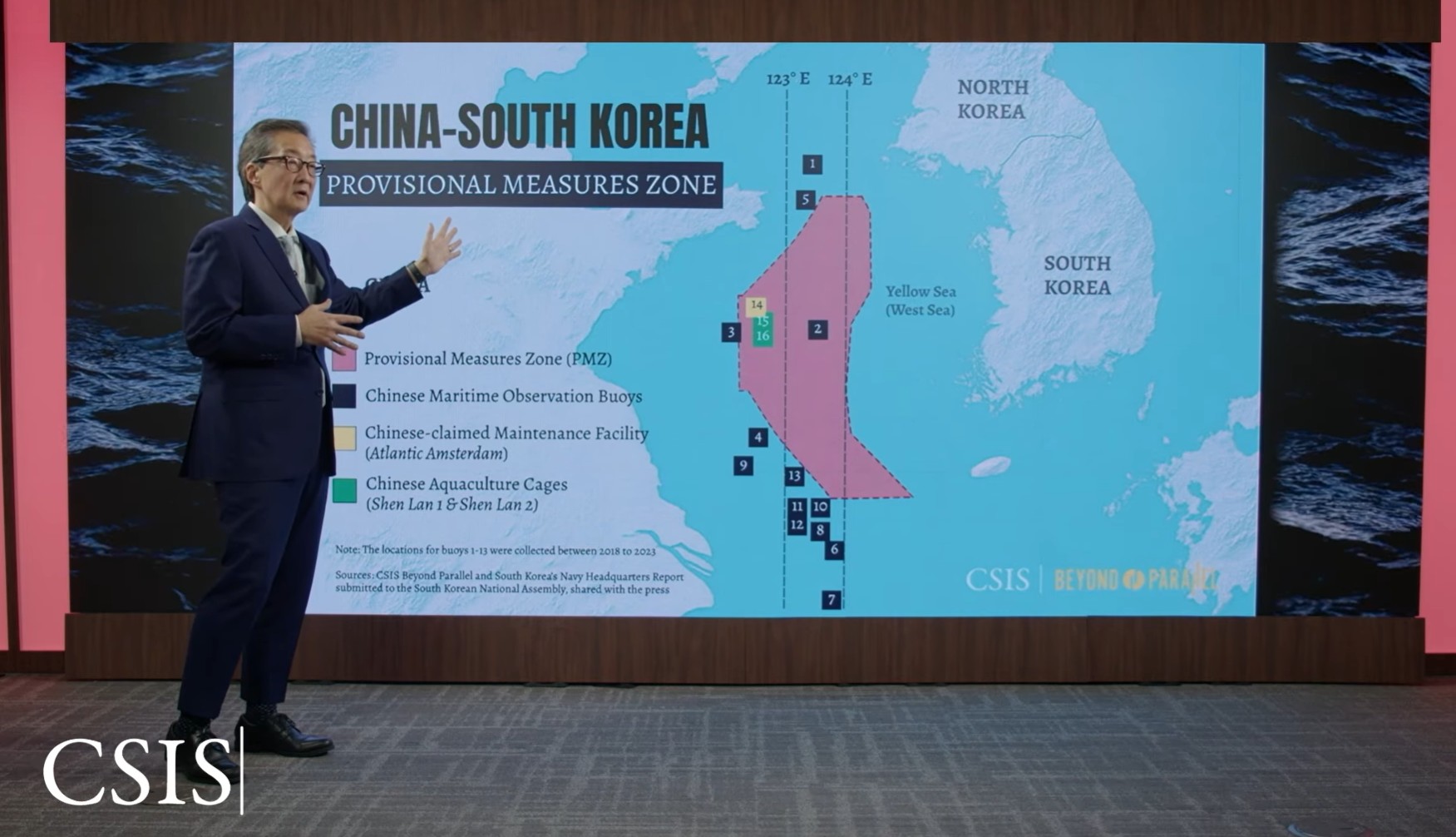
China has unilaterally deployed surveillance buoys and massive industrial platforms in the Yellow Sea waters shared with South Korea, raising concerns that Beijing is expanding its “grey zone” tactics to assert control over disputed maritime areas, according to a new analysis by the Center for Strategic and International Studies (CSIS).
Since 2018, Beijing has installed 13 buoys and three permanent structures in or near the Provisional Measures Zone (PMZ), a maritime area established under a 2001 fisheries agreement to manage overlapping Exclusive Economic Zone (EEZ) claims between the two nations.
Victor Cha, CSIS President of Geopolitics and Foreign Policy, stated that these installations were established “without prior consultation with South Korea,” violating the spirit of the joint management agreement.
“The agreement encouraged transparency, rulemaking, and mutual consultation in this shared maritime zone,” Cha said in a video analysis released by the think tank. Instead, the report suggests China is engaging in “creeping sovereignty” by increasing its physical presence while avoiding direct military conflict.
Dual-Use Concerns
Of particular concern to Seoul is the potential military application of the deployed technology. While Beijing maintains that the 13 buoys are strictly for meteorological observation, CSIS warns of “dual-nature capabilities.”
One specific unit, identified as Buoy Number 12, features extensive solar arrays, suggesting it is designed for “long-duration autonomous operations that require sustained power generation.” According to the analysis, this power capacity could support environmental sensors, AIS receivers, or communication modules capable of tracking maritime traffic.
“Although the physical characteristics visible in the photographs are consistent with China’s stated explanation, photographs alone cannot confirm the full range of these functions,” Cha noted. He added that the designs “do not preclude the possibility of dual-use capabilities.”
Industrializing the Sea
Beyond the buoys, China has constructed substantial permanent infrastructure within the zone. This includes two massive aquaculture cages, the Shen Lan 1 and Shen Lan 2, designed to breed Atlantic salmon. The Shen Lan 2 stands 71 meters tall and can reportedly hold one million fish.
Supporting these cages is the Atlantic Amsterdam, a converted offshore oil drilling rig that now serves as a “central integrated management platform.” The scale of the structure is significant; the report cited a 2023 Chinese newspaper description calling the platform “the equivalent to building a new island next to the cage.”
Grey Zone Tactics
The report highlights that these deployments mirror Beijing’s behavior in other contested waters, such as the South China Sea. South Korean attempts to monitor these activities have met with resistance. According to CSIS data, South Korean research vessels have been intercepted by the Chinese Coast Guard 27 times out of 135 attempts since 2020.
“China’s harassment of South Korean vessels resembles ‘creeping sovereignty’ grey zone tactics in the Yellow Sea that Beijing has employed in the militarization of the South and East China Seas,” Cha said.
The analysis calls for the United States and South Korea to publicly flag these activities and release the coordinates of the structures. It urges Washington to support Seoul’s claims regarding violations of the 2001 agreement.
Citing the U.S. National Security Strategy, Cha concluded that “strong measures must be developed along with the deterrence necessary to keep those lanes open, free of ‘tolls,’ and not subject to arbitrary closure by one country.”