As the global economy concludes the first quarter of the 21st century, China stands as a nation fundamentally transformed, having evolved from a low-cost manufacturing hub into a technological superpower now seeking to rewrite the international order. However, a new special report by Bloomberg Television highlights that this rapid ascent has created a “tale of two Chinas,” where industrial dominance in sectors like electric vehicles masks deepening domestic fractures and a stalling consumer economy.
The retrospective, anchored by David Westin, traces the arc of China’s rise back to its entry into the World Trade Organization in 2001. According to Bloomberg’s Enda Curran, that moment was the catalyst that allowed Beijing to tap into global markets, eventually positioning the nation to rescue the global economy during the 2008 financial crisis through massive infrastructure spending.
“China joining the WTO in 2001 was probably one of the most consequential decisions, not just for China’s economy, but for the world economy,” Curran stated, noting that subsequent investments in high-speed rail and ports laid the groundwork for the country to become the world’s second-largest economy.
A Shift in Global Posture
The report emphasizes that China’s ambitions have shifted from economic integration to geopolitical dominance. Elizabeth Economy, a senior fellow at the Hoover Institution, noted that the Beijing of 2000, which sought to adapt to international norms, has vanished.
“What we see today is pretty radically different from what we saw in 2000,” Economy said. “You have China no longer being a rule-taker, but a rule-maker.”
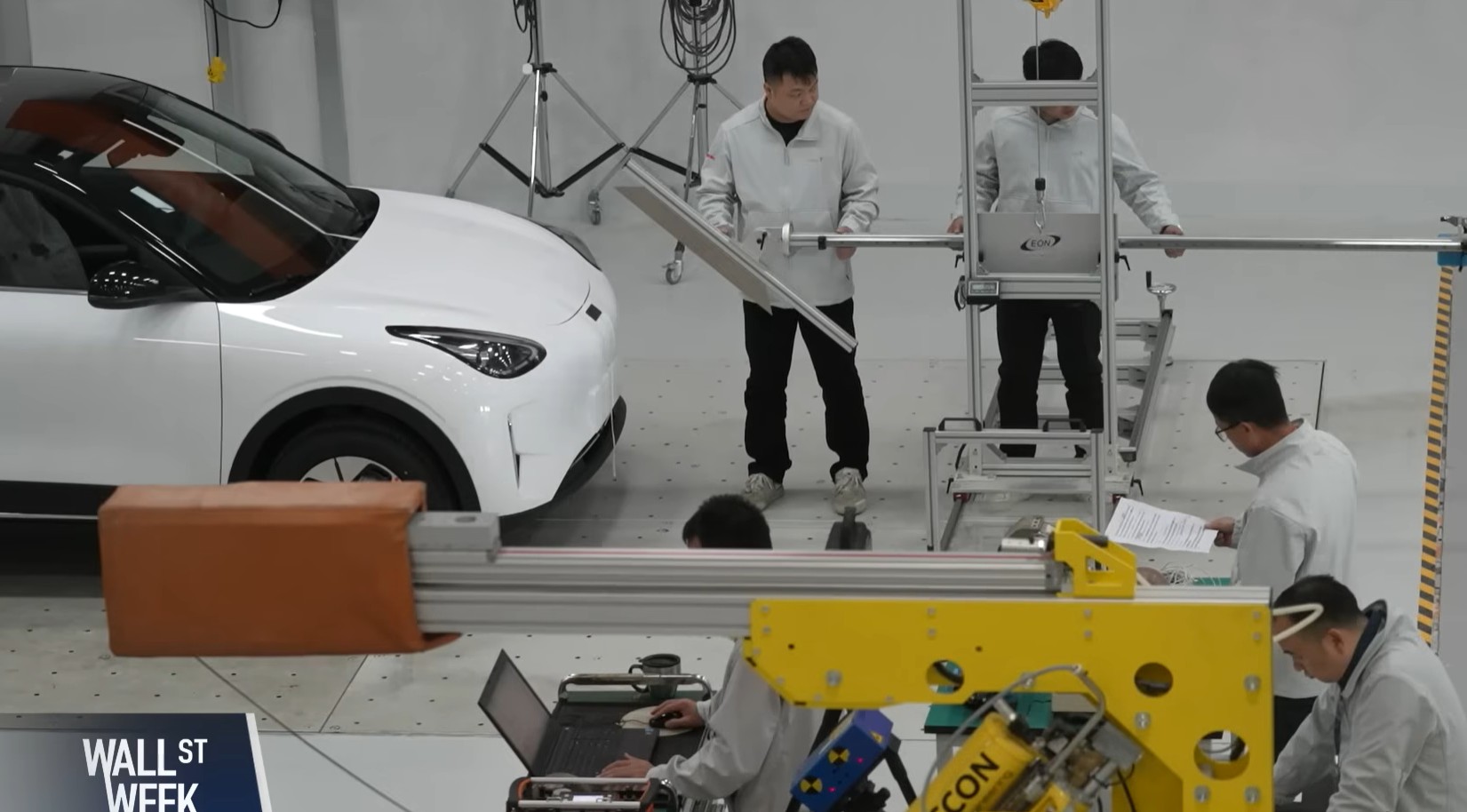
This confidence is driven by a state-led model that has successfully pivoted toward high-end manufacturing. While Western nations grapple with the transition to green energy, China has established a commanding lead. During a recent visit to a Chinese electric vehicle facility, Economy described a level of automation and efficiency that rivals Western capabilities.
“They are producing 300,000 EVs in a year, and they only have 2,100 people on their factory floors. And the factory is spotless; you could eat off the floor,” she observed.
Afsaneh Beschloss, CEO of RockCreek, added that Western observers often cling to an outdated view of China as a producer of basic consumer goods. “Today, it’s a whole other world,” Beschloss said. “The batteries that they are producing are so far ahead of the ones we are producing… They are jumping ahead in ways that we did not expect.”
The “Tale of Two Chinas”
Despite these industrial triumphs, the report illuminates a darkening domestic picture. The property sector slump and a lack of consumer confidence have cast a “gray pall” over major cities like Beijing, where the construction cranes that once defined the skyline are notably absent.
Economy described the current landscape as “very much an economy of haves and have-nots,” noting that while the tech elite surge ahead, consumption for the average citizen has not rebounded. Furthermore, the very automation driving China’s manufacturing success is creating a new crisis: a lack of jobs. Economy recounted how local governments are now pressuring autonomous vehicle factories to find employment for the very drivers their technology displaces.
Supremacy Over Consumption
For years, Western economists have argued that China must transition from an export-led model to one driven by domestic consumption to ensure sustainable growth. However, the panelists suggest that President Xi Jinping has a different priority.
“They’re not interested in domestic consumption. They’re interested in world supremacy,” Beschloss argued. She noted that Beijing is pouring capital into quantum computing, AI, and robotics with a singular focus on national power rather than consumer prosperity.
This divergence has significant implications for the United States. Beschloss warned that while China leverages state capital to accelerate technological development, the U.S. risks falling behind by underinvesting in its own innovation engine.
“Who would expect that the U.S. would be kneecapping its own universities, its own research, its own biotech… investing less in technology at scale,” Beschloss said, contrasting this with China’s aggressive, albeit state-controlled, approach.
As China moves into the next phase of its development, the report suggests the country is becoming more closed off and overconfident, betting its future on technological self-reliance and global influence rather than the integration and liberalization the West once hoped for.
“They are confident that they are on the right trajectory,” Economy concluded, even as the country navigates the friction between its high-tech ambitions and a slowing domestic reality.