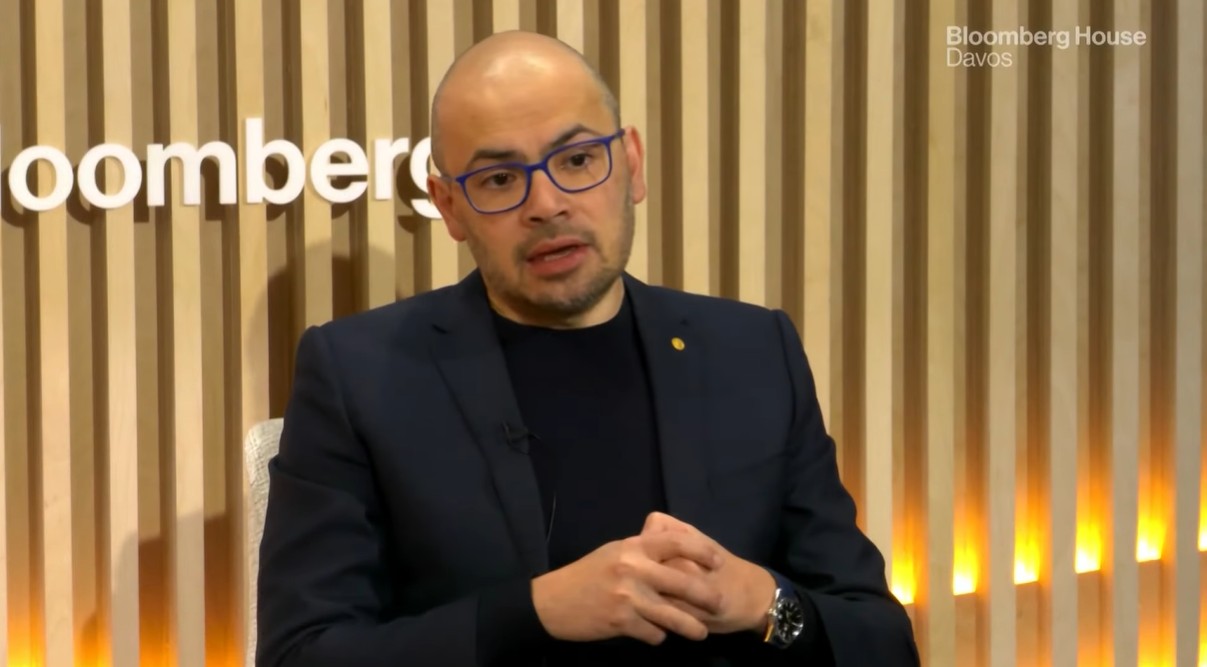
Google DeepMind CEO Demis Hassabis projected a renewed sense of stability for the tech giant on Monday, pointing to a “startup energy” that has taken hold following the release of Gemini 3.
Speaking with Bloomberg’s Emily Chang at the World Economic Forum, Hassabis suggested that the internal “code red” urgency of previous years has evolved into a sustainable, albeit intense, operational norm. He argued that Google remains the only organization possessing the “full stack” necessary to win the AI race, from custom TPU silicon and data centers to the frontier labs and consumer products like Search and Chrome.
The Push for Physical Intelligence
But the digital realm is only half the battle. Hassabis predicted a major breakthrough in “physical intelligence” is imminent, likely arriving within 18 months to two years. He compared the current state of robotics to “jagged intelligence”—systems that are brilliant at specific functions but lack the consistency to be autonomous. The goal is to build robots that can perform useful tasks reliably, moving beyond the prototype stage to handle the dexterity required in the real world.
2030
Projected arrival of AGI (50% probability)
Competition and Global Safety
The CEO offered a cool assessment of the competitive landscape, specifically regarding the “DeepSeek” development that shook Western markets a year prior. While acknowledging the speed at which Chinese firms can catch up to state-of-the-art benchmarks, he remains skeptical of their ability to set the pace.
“I think they’ve yet to show they can innovate beyond the frontier.”
— Demis Hassabis, CEO of Google DeepMind
On the subject of Artificial General Intelligence (AGI), Hassabis held firm to his prediction that such a system—one matching human cognitive capabilities across the board—has a 50 percent chance of arriving by 2030. Unlike some of his peers who foresee a rapid collapse of the white-collar job market within five years, Hassabis believes the transition will be more gradual. Current models are still too inconsistent to be fully delegated critical tasks without human oversight.
Context
Addressing the technical debate over whether large language models have hit a ceiling, Hassabis dismissed the idea that the industry has reached a dead end. He advocated for a dual approach: continuing to scale existing methods while inventing new architectures to solve problems like reasoning and long-term planning.
Hassabis also reiterated his desire for an international regulatory body modeled after CERN to govern the safety of these systems. He warned that without global coordination, isolated western regulations would be ineffective. If and when the technology solves the economic needs of humanity, Hassabis intends to pivot back to his roots: using AGI to investigate the “fabric of reality,” from the nature of consciousness to the Fermi paradox.
“We just go around our daily lives not really thinking about these massive questions that, for me, are almost screaming at me. What is the answer to these deep mysteries?”
— Demis Hassabis