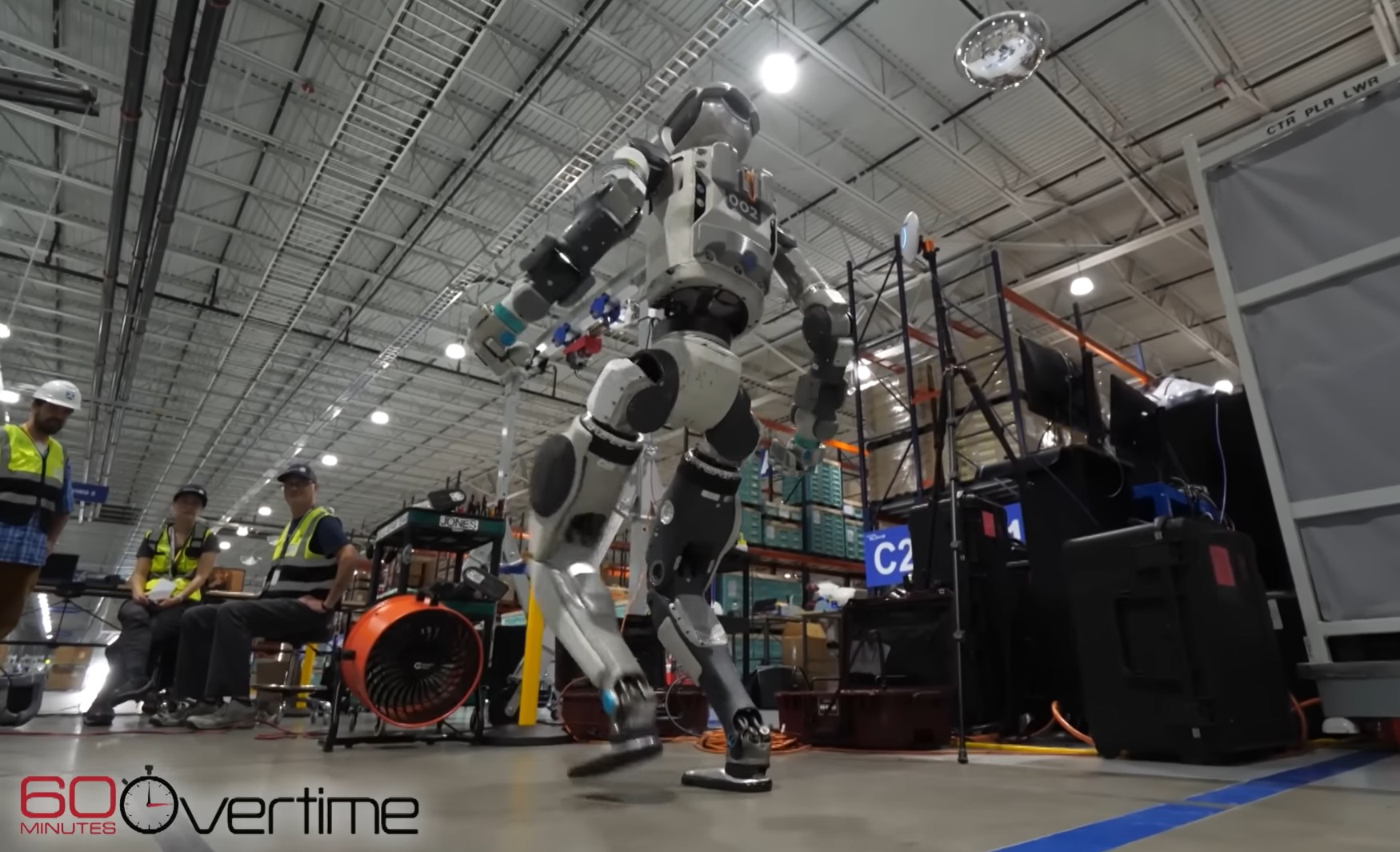
The humanoid robot that spent a decade becoming an internet celebrity for its parkour skills is finally clocking in for a real job. Boston Dynamics, backed by parent company Hyundai Motor Group, unveiled the fully commercial version of its Atlas robot at CES 2026, positioning the machine as a direct replacement for human labor in industrial manufacturing.
Executives presented the new electric model not as a research project, but as a finished product ready for mass deployment. The company has spent years refining the platform, waiting for artificial intelligence to catch up with mechanical capability.
“The rapid advancements in AI over the past few years are the piece that we needed.”
— Boston Dynamics Presenter
Industrial Design
Atlas demonstrated its capabilities on stage by rising from a prone position with a jarring, mechanical efficiency that abandoned human kinematics entirely. The robot’s joints rotate 360 degrees, allowing it to move in ways biological workers cannot. This design choice reflects a philosophy that values industrial output over strict biomimicry. The machine is strong, capable of lifting 110 pounds and reaching heights of 7.5 feet, surpassing the physical limits of many human workers.
Context
Hyundai has already deployed the robot for testing at its Metaplant in America. Footage shown during the presentation depicted Atlas performing autonomous material handling tasks, confirming that the machine can operate independently on chaotic job sites. A new software platform called Orbit allows the robots to share data instantly; when one unit learns a new skill, the entire fleet updates.
Durability and Scale
Durability was a central focus of the engineering team. The production model is water-resistant and operational in temperatures ranging from minus 4 to 104 degrees Fahrenheit. To maintain continuous operation, the robot autonomously navigates to a charging station and swaps its own battery when power runs low.
Production is already underway at the company’s headquarters in Boston. The entire supply for 2026 has been allocated to Hyundai and an unnamed AI partner, with broader commercial availability scheduled for 2027. The unveiling marks a definitive shift from treating humanoid robots as research curiosities to viewing them as scalable industrial appliances.
30,000
Target Annual Production Capacity
“We are building a new robotics factory capable of producing 30,000 Atlas robots a year… creating an engine for deploying tens of thousands of Atlas robots.”
— Hyundai Motor Group Executive