In a comprehensive new report by The Telegraph, the multifaceted struggle for Odesa—Ukraine’s vital port city—has been laid bare, revealing a city fighting for its survival on the waves, in the skies, and within its own history.
The report, led by Associate Editor for Defence Dominic Nicholls, grants exclusive access to the various layers of defense protecting the “Pearl of the Black Sea,” beginning on the water. Odesa remains the heartbeat of Ukraine’s economy, serving as the critical node for the grain corridor that helps stabilize global food prices.
Nicholls accompanied the Ukrainian Navy on a patrol aboard a coastal defense craft recently gifted by Estonia. While the Black Sea has been a theatre of fierce combat—with Ukrainian forces striking Russian vessels and Russia targeting port infrastructure—the patrol revealed the surreal nature of modern naval warfare.
Personnel on board described the interception of Iranian-designed Shahed drones using a .50 caliber Browning machine gun fitted with thermal imaging. One operator described the lethal process with chilling detachment.
“This, I think, is an easy computer game, a joystick, a monitor,” the sailor told The Telegraph. He explained the visual confirmation of a successful hit: “It ignites in the air and either falls like a fireball or explodes mid-air, that’s all.”
Despite the threat of drones, the crew noted a perverse safety in being at sea; Russian ballistic missiles are pre-programmed to strike static port infrastructure, making the open water often safer than the coastline.
The Hunters in the Dark
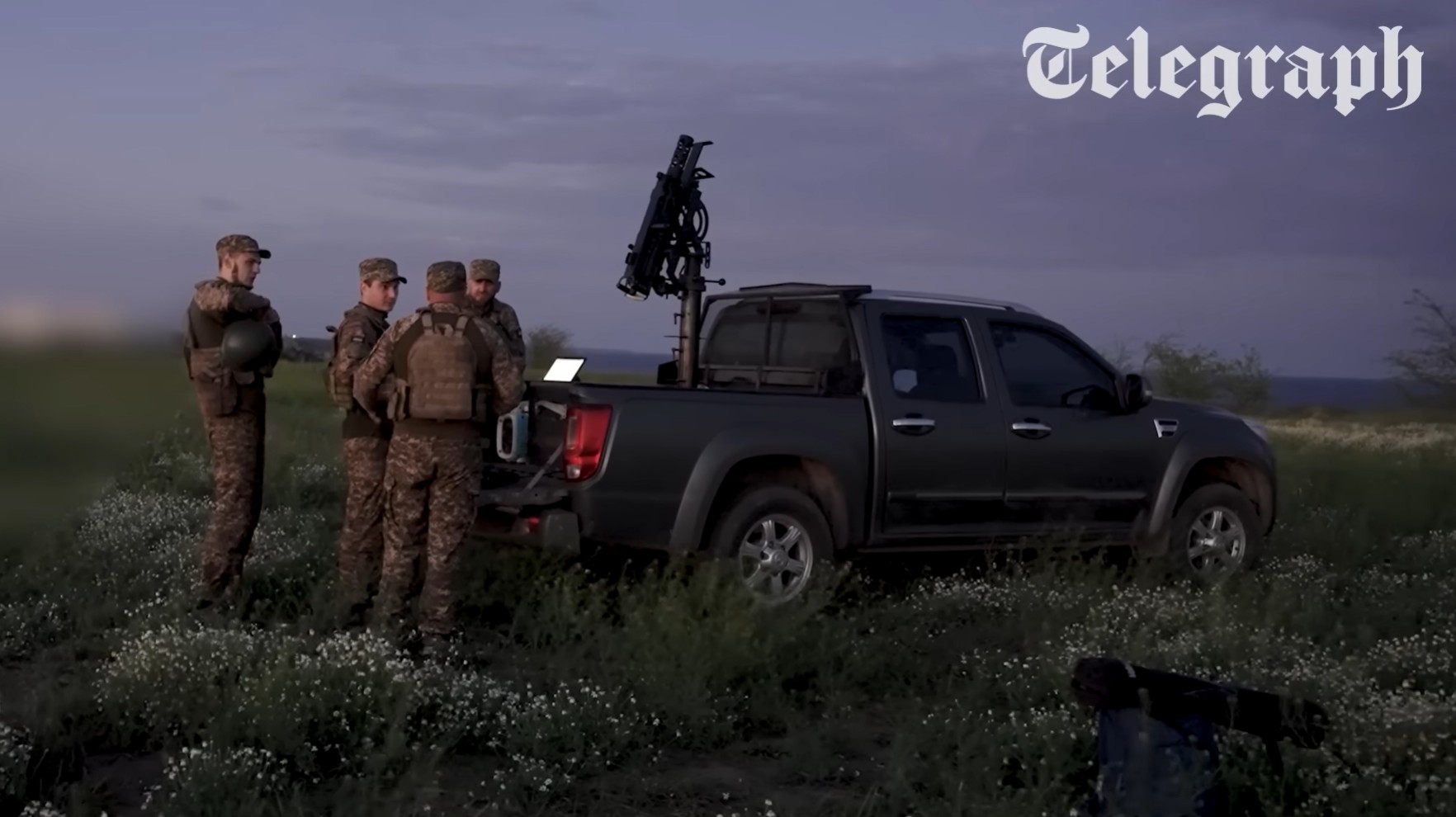
On land, the defense of Odesa relies on mobile anti-drone units that patrol the countryside in pickup trucks, waiting for the nightly Russian barrages. These units, part of the 11th Brigade of the National Guard, utilize tablet computers linked to radar feeds to track incoming threats in real-time.
Slava “Naum,” a member of one such unit, admitted that the enemy is evolving. “Yes, definitely, they’re improving their attacks against Ukraine,” he said. “They create a big swarm with 10 to 15 units approaching the city. And that’s why it’s hard to intercept them.”
To combat this, troops are honing their skills using Virtual Reality (VR) headsets at secret training centers, simulating the lead and elevation required to shoot down moving targets with heavy machine guns.
The War for Identity
Beyond the kinetic warfare, The Telegraph’s report highlights a fierce internal struggle over Odesa’s cultural identity. Historically a Russian-speaking city with deep imperial ties, the invasion has fractured its relationship with its past.
At the center of this debate is a prominent statue of Russian poet Alexander Pushkin. While some residents view him as a historical fixture, others see him as a marker of imperialism that must be removed.
“Any culture needs to be treated with respect,” an older resident argued near the monument. “Besides, Pushkin made Odesa famous.”
However, Tetyana Kagitina, a local interviewed by the outlet, expressed the shifting sentiment caused by the relentless bombardment. “To be honest… I like it as a statue. I was grown up here,” she said. “But I don’t want to have anything connected with Russian culture and Russia itself.”
This cultural divorce extends to the city’s famed Philharmonic Orchestra. Hobart Earle, the American-born music director and principal conductor, confirmed a total ban on Russian compositions.
“When the invasion happened, from that day on, there has not been a note of Russian music performed,” Earle stated. “The country’s been invaded, people are dying every day. They don’t want to hear Russian music now.”
The Physical Cost
The report concludes with a sobering look at the physical toll of the war. In a nondescript, Soviet-era building, a factory is now churning out 700 polyurethane prosthetic feet per month—enough to meet the current demand for the entire country.
The facility produces limbs for both soldiers and civilians, including children. Inside, Nicholls encountered a 63-year-old veteran receiving a new prosthetic leg. In a poignant moment of connection, the two men realized they had both served in Afghanistan during the 1980s—Nicholls for the British Army and the amputee for the Soviet Army.
Reflecting on the technology that allows him to walk, the veteran offered a perspective that applies as much to the prosthetics as it does to the city’s defense: “A good prosthetic depends more on the master than on the technology itself.”