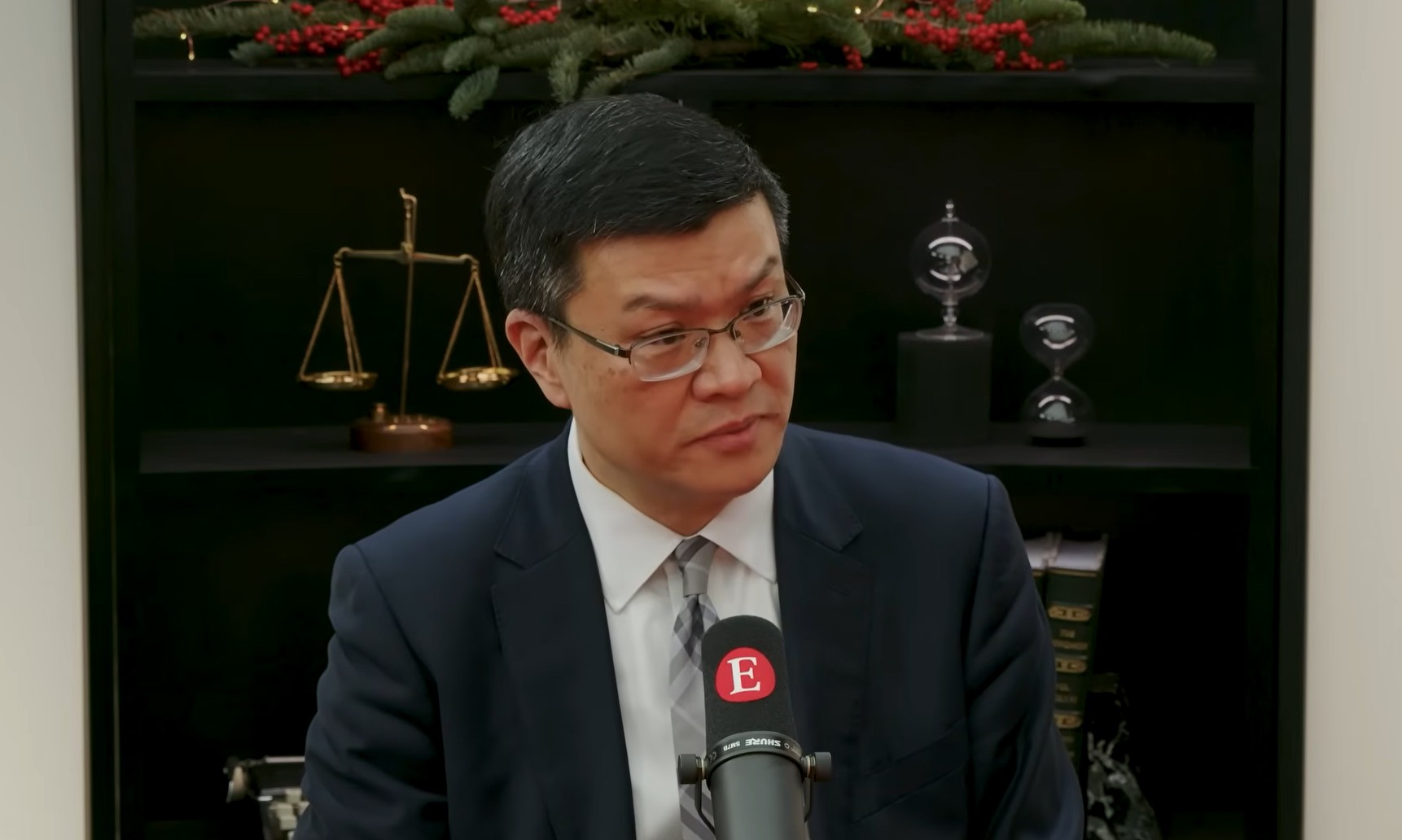
A leading Chinese foreign policy scholar has dismissed the notion that Beijing views a Donald Trump presidency as an opportunity to strike a transactional “grand bargain” over Taiwan, asserting that the island’s sovereignty cannot be traded like a commodity.
In a recent interview with The Economist’s geopolitics editor David Rennie, Da Wei, a professor and director of the Centre for International Security and Strategy at Tsinghua University, pushed back against the theory held by some Washington hawks that China might expect Trump to trade away support for Taiwan in exchange for trade concessions.
“At least I don’t think so, and I don’t think a lot of my colleagues in Beijing view this in that regard,” Da Wei said. He emphasized that the complexity of the situation transcends simple economic bartering.
“To be honest, Taiwan is not a mug on the table. You cannot sell it, you cannot buy it,” Da Wei stated. “There are 23 million people living on the island.”
The discussion, recorded on December 16, highlighted the yawning gap between Beijing’s ambitions for reunification and the democratic reality of Taiwan. When pressed by Rennie on whether Beijing intends to apply the same “patriotic re-education” methods used in Hong Kong to the people of Taiwan, Da Wei acknowledged the difficulty of the task.
Referring to the 1997 handover of Hong Kong, Da Wei noted that while political sovereignty changed decades ago, social integration remains incomplete. “The experience in Hong Kong tells us that the reunification… at a superficial level, it’s not enough,” he said. “Reunification needs a unification of society, of the identity.”
He argued that full unification is not achieved “until the majority of people believe they are Chinese.”
Rennie challenged the professor on the compatibility of Beijing’s definition of “patriots governing”—which in Hong Kong requires loyalty oaths to the Communist Party—with Taiwan’s “noisy, raucous democracy.” Da Wei conceded that forcing the current Hong Kong model onto Taiwan is not the immediate strategy, suggesting that “Taiwan has its own version of One Country, Two Systems” which has yet to be fully defined.
However, Da Wei remained firm on the ultimate requirement for loyalty should reunification occur. “If it’s a unified country, you need to be loyal to the government, to the system,” he told The Economist.
Addressing the geopolitical landscape under a potential Trump administration, Da Wei rejected the idea that Beijing is preparing for imminent military action to exploit a perceived US retreat from alliances. He described the use of military force as “a very difficult choice for anyone.”
Instead, he suggested that Beijing hopes the US will alter its diplomatic stance. “I do think there is an opportunity for China and the US to work on [the] Taiwan issue,” Da Wei said, adding that Beijing would encourage Washington to “clarify their One China policy further,” noting that from China’s perspective, the US role regarding Taiwan “has not been very constructive in [the] past four decades.”