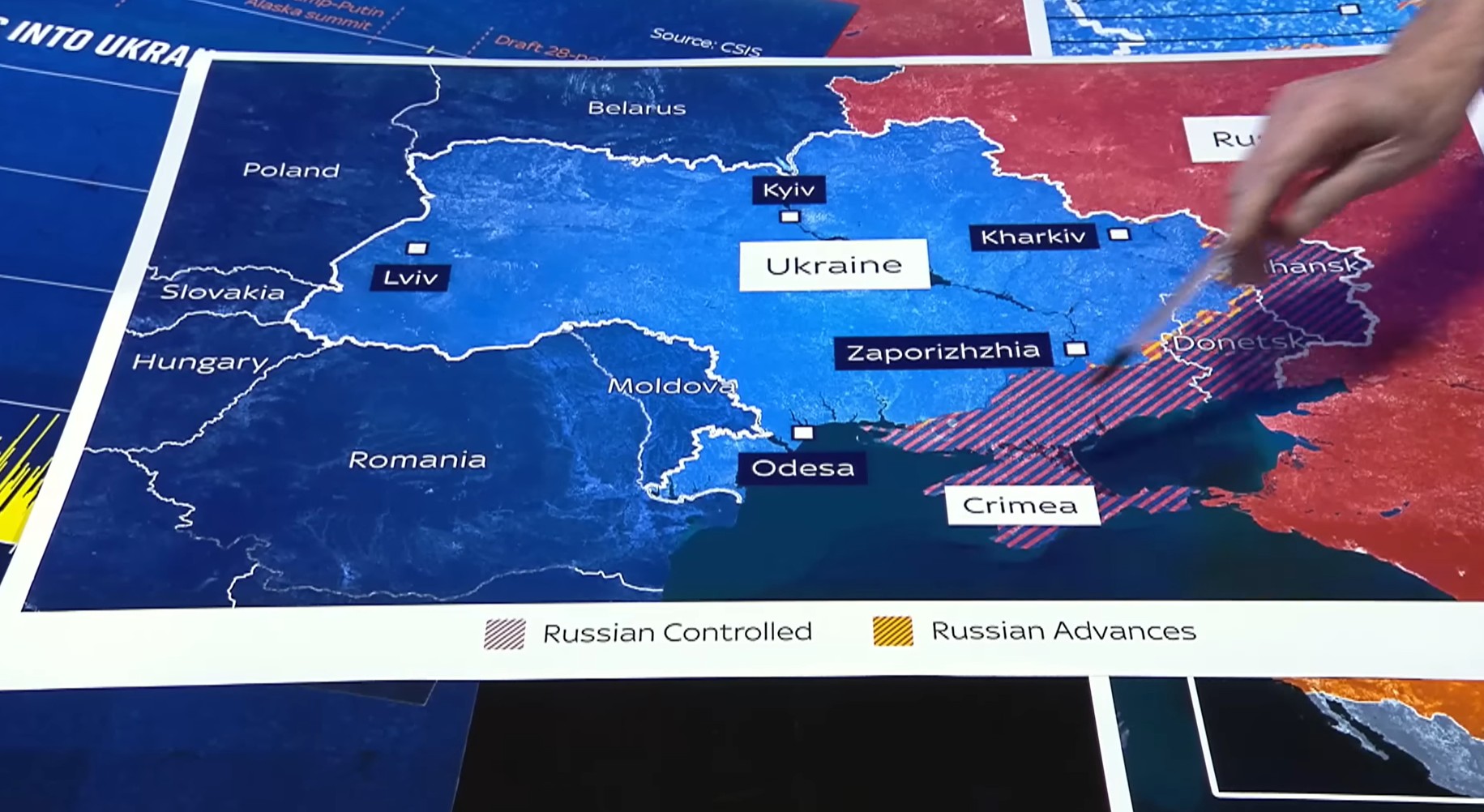
As the war in Ukraine approaches the four-year mark, the conflict has evolved into a grinding stalemate defined by “industrial age warfare” and a technological revolution that has fundamentally altered the battlefield. In a special year-end analysis for Sky News, security and defence analyst Professor Michael Clarke warns that while Russia has not achieved a strategic victory, it has successfully secured a “victory of the narratives” in the West, placing the transatlantic alliance in unprecedented peril.
According to the analysis by Sky News, nearly four years after the full-scale invasion began in February 2022, Russia currently controls approximately 20 percent of Ukrainian territory. While the front lines have remained relatively static, the nature of the fighting has shifted dramatically. Professor Clarke describes the current state of combat as a hybrid of trench warfare and “sixth-generation warfare,” dominated by robotics and artificial intelligence.
The introduction of pervasive surveillance drones has created a deadly transparency on the front lines. In a stark assessment of modern combat conditions, Clarke notes that a zone of approximately 40 kilometres on either side of the front line has become a death trap for armoured vehicles.
“The drones don’t allow anybody to move around without being spotted,” Clarke told Sky News. “At the moment, on average, if you’re spotted, then you’re targeted within about seven minutes.”
This transparency has forced a shift away from traditional manoeuvre warfare. Data compiled by Sky News forensics teams highlights a massive ramp-up in Russian industrial output throughout 2025. Charts presented during the broadcast depict a stark increase in Russian drone and missile launches, significantly outstripping Ukrainian intercept capabilities.
“This is industrial age warfare,” Clarke explained. “They’ll do whatever it takes… to outproduce anything that the Ukrainians can produce themselves.”
The Diplomatic fracture
Beyond the battlefield, the analysis suggests the geopolitical landscape has shifted just as radically, particularly regarding the role of the United States and the potential return of Donald Trump to the world stage.
The broadcast highlighted a fracturing of the NATO alliance, dividing the continent between what Clarke terms the “toughies”—the UK, Poland, the Baltic states, and Scandinavia—and the southern European nations that take a “softer view.” However, the most significant variable remains the United States.
With discussions of peace deals circulating, Clarke warns that the historical unity of the West is fracturing. “Every American president from Harry Truman onwards would have been prepared to go to war to maintain the transatlantic relationship,” Clarke stated. “President Trump indicates that that is over now.”
The analysis suggests that the Kremlin has capitalized on political divisions in Washington. Despite the high casualty rates and economic cost to Russia, Moscow has effectively convinced significant portions of the US political establishment that their momentum is inevitable.
“In the United States, the Russians have achieved the victory of the narratives,” Clarke observed. “Because they’ve convinced the US that they are unstoppable, even though the rest of us don’t think they are.”
A ‘Cheap and Dirty’ Peace?
Looking ahead to 2026, the report paints a sombre picture for Kyiv. The fear among European allies is that Ukraine may be forced into a “cheap and dirty deal” that cedes territory—specifically the Donbas—in exchange for a cessation of hostilities. Clarke warns that such a deal would likely leave Ukraine as a non-viable “rump state” and would eventually lead to further Russian aggression.
The analysis concludes that 2026 poses a fundamental existential challenge for European NATO members: whether they can or will support Ukraine without the full backing of the United States.
“I have never known a time in my lifetime as an analyst where the Atlantic Alliance has been in such trouble,” Clarke concluded. “The Europeans have got to be very brave about this.”