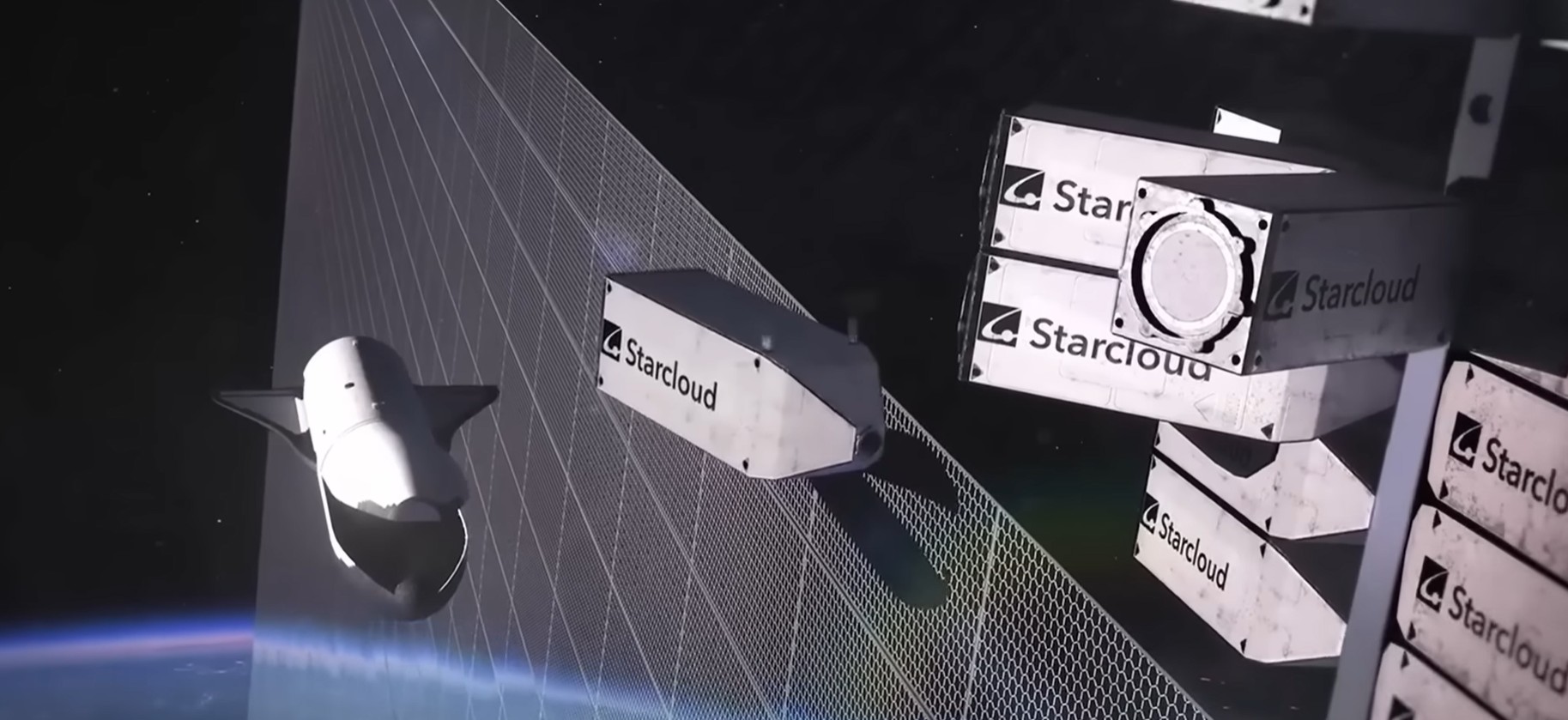
The race to dominate artificial intelligence has found a new, unlikely frontier: low Earth orbit. According to a detailed analysis by orbital dynamics expert and science communicator Scott Manley, what began as a niche concept by small startups has rapidly evolved into a strategic imperative for the world’s largest technology and aerospace companies.
In a comprehensive report released this week, Manley details how the constraints of Earth’s power grids and the plummeting costs of rocket launches have created a perfect storm, driving a migration of high-performance computing into the vacuum of space.
The Power Problem
The primary driver of this extraterrestrial gold rush is not a lack of land or water on Earth, but a scarcity of electricity. As AI models grow exponentially, terrestrial data centers are straining municipal power grids, leading to political pushback. Manley highlights recent calls by U.S. politicians, including Senator Bernie Sanders, for a moratorium on new data center construction.
“Water is not the limiting factor here, it is power,” Manley explains. “The power that data centers are drawing from the grid means that more and more power [supplies] need to be spun up.”
The solution proposed by industry leaders is to bypass the grid entirely. By placing data centers in orbit, operators can access 24/7 solar energy—uninterrupted by night or weather—provided they select specific “sun-synchronous” orbits.
The Heavy Hitters Enter the Arena
While startups like Lumen (recently rebranded as Starcloud) pioneered the concept with proof-of-concept satellites now training Large Language Models (LLMs) in orbit, established titans are moving in.
Manley reports that Google has released a white paper titled “Project Suncatcher,” analyzing the economics of scaling machine learning in space. Furthermore, unconfirmed reports regarding SpaceX’s anticipated initial public offering suggest that the company’s valuation—rumored to approach $1.5 trillion—is predicated on capitalizing on this new market.
“The word on the street was that [Eric Schmidt] was really focusing on them as a launch company for the forthcoming boom in data centers in space,” Manley notes, referencing the former Google CEO’s investment in Relativity Space. Regarding SpaceX, Manley adds that the move is “effectively a race, not just to get the hardware up there, but to claim the best orbits for your stuff.”
The Economics of Orbit
The financial viability of orbital compute hinges on the falling cost of launch. Manley references an economic modeling tool created by Andrew McCalip of Varda Space Industries, which suggests that while space-based compute is currently estimated to be three times more expensive than terrestrial counterparts, the gap is closing rapidly.
The analysis compares historical satellite costs against modern architectures like SpaceX’s Starlink. “If you take that same $3,600 per kilogram launch cost, then your kilowatt per year cost is now $14,700,” Manley calculates. However, if launch costs drop to $200 per kilogram—a target for next-generation vehicles like Starship—the cost of energy becomes highly competitive with Earth-based alternatives.
Engineering Challenges
Critics often cite thermal management as a showstopper for space data centers, noting that radiating heat in a vacuum is notoriously difficult compared to water-cooling on Earth. Manley, however, argues that the problem is solvable through distributed constellations rather than massive monoliths.
“My simplest argument is we have Starlink V2,” Manley states. “We have them feeding that power into the core satellite bus with the compute, with the antennas, and it is operating fine… Replace those electronics with CPUs, and you have the same thermal profile.”
Furthermore, concerns regarding radiation causing data errors (bit flips) appear manageable. Google’s testing of their Tensor Processing Units (TPUs) in proton beams suggests that the architecture of neural networks is inherently robust. “Some of those processes are actually pretty robust against random noise,” Manley observes.
A New Industrial Revolution
Ultimately, the push for orbital data centers represents a shift toward what Amazon founder Jeff Bezos has described as moving heavy industry off-Earth to protect the planet. It is a vision of the future where the immense energy required to advance civilization is harvested from the sun, rather than extracted from the Earth.
As Manley concludes, quoting McCalip’s analysis on the motivation of the billionaires funding these projects: “If you’ve built an empire, the best possible use of it is to burn its capital like a torch… Fund the ugly middle. Pay for the iteration loops. Build the cathedrals. This is how we advance civilization.”