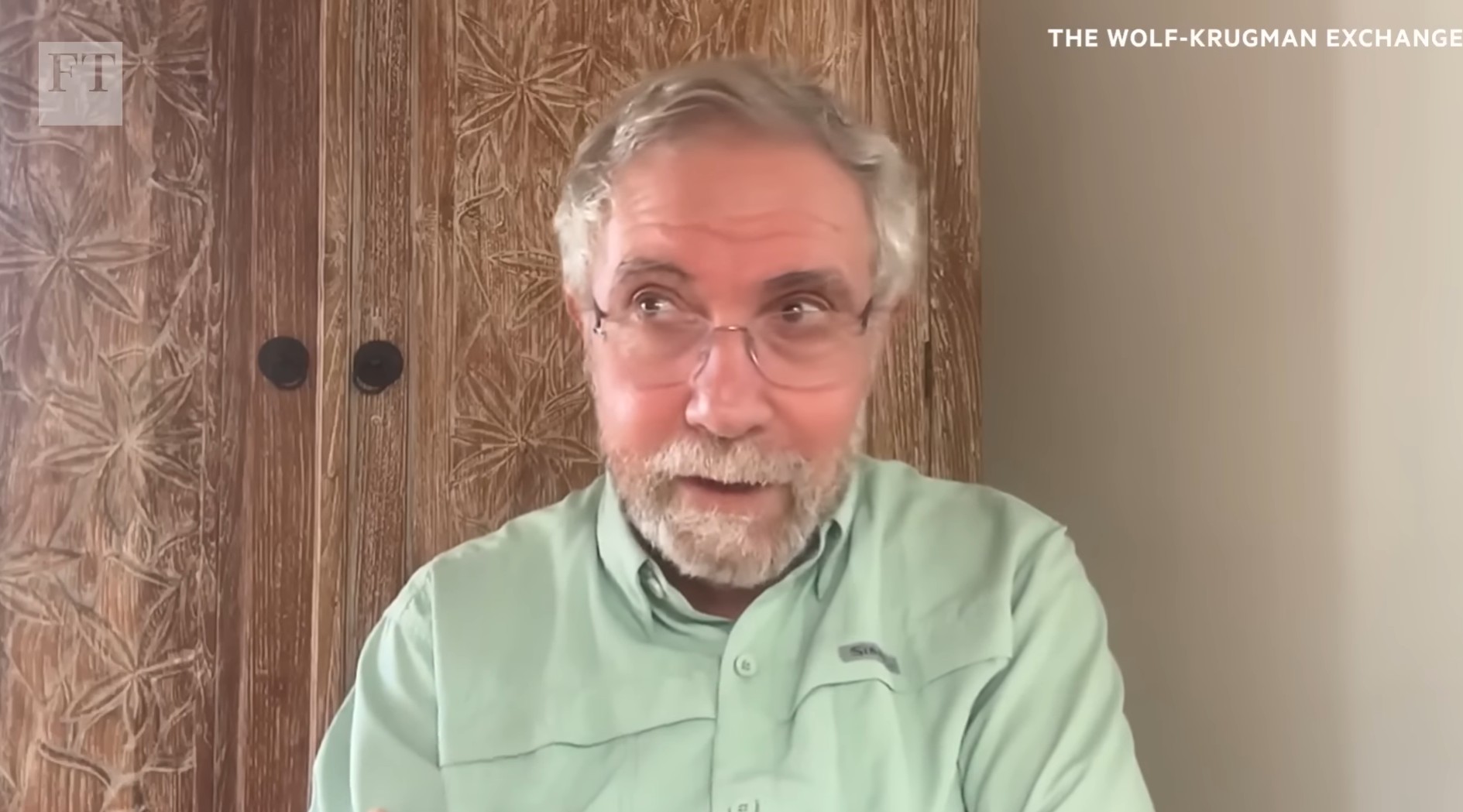
In the season finale of “The Wolf-Krugman Exchange,” two of the world’s most prominent economic thinkers, Martin Wolf and Nobel laureate Paul Krugman, turned their attention to questions from their audience. The discussion, ranging from the legacy of 1980s deregulation to the rise of artificial intelligence, coalesced around a central, darkening theme: the erosion of democratic capitalism by entrenched wealth and the rise of a new oligarchic class.
While popular narratives often blame globalization for the hollowing out of the Western middle class, Krugman and Wolf argued that the rot lies closer to home. Responding to a listener who traced today’s ills to the free-trade policies of the Reagan era, Krugman pushed back against the idea that trade is the sole culprit.
“It’s not all about globalization, and that I think is a trap,” Krugman said. He pointed to Germany, a trade-surplus superpower that retains a strong manufacturing base yet suffers from similar social fractures and populist backlashes as the United States. “The death of unions is a much bigger issue in the United States, and that’s not really mostly even about globalization. It’s mostly about hostile policies.”
Wolf, the FT’s chief economics commentator, concurred, identifying a shift in corporate philosophy rather than trade flows as the primary driver of inequality. He noted that the doctrine of shareholder value maximization, which took hold in the 1980s, fundamentally altered the social contract. “The extreme version of shareholder control… clearly changed very radically how companies behaved,” Wolf observed.
The Era of the Plutocrat
The conversation took a sharper turn when addressing the influence of money in politics. Both economists suggested that the traditional critique of corporate power is becoming outdated, replaced by the influence of individual billionaires.
“We talk too much about corporations and not enough about plutocrats,” Krugman argued. “Amazon is a giant corporation, but it’s kind of Jeff Bezos that’s the problem.”
Krugman warned that the United States is sliding toward a system of “raw corruption” and a revolving door between government and private wealth that makes the “robber barons look like petty thieves.” Wolf added that this concentration of wealth has allowed a small class of owners to exert “huge political power,” particularly through the US judicial system and campaign finance, making it “very difficult to create a coalition that will resist contemporary oligarchic capitalism.”
Europe’s “Decline” and the Cost of Defense
Turning to Europe, the duo dismantled the prevailing narrative coming from Washington that the continent is in terminal economic decline. Krugman cited recent remarks by US officials comparing Europe’s economic output to that of Mississippi.
“Get out of your darned limo and walk around,” Krugman retorted, noting that while the US leads in tech, Europe often outperforms on fundamental quality-of-life metrics such as life expectancy and safety. “All of the numbers that show Europe with declining relative productivity are all based on a very narrow observation, which is that the United States leads in tech.”
With the geopolitical landscape darkening, however, the question of European security—and its cost—loomed large. Both economists agreed that Europe and the UK have the fiscal capacity to increase defense spending to match Russian aggression without dismantling their welfare states.
“We’re talking about raising defense spending from below 2% to maybe 4% of GDP,” Wolf said. “Universal healthcare would not be threatened, nor the whole welfare state… modest reductions in spending, maybe a percentage point each, and you’re there.”
China’s “Right-Wing” Communism
On the subject of China, Wolf and Krugman highlighted a persistent structural flaw: the regime’s refusal to boost domestic consumption. Despite the need to rebalance the economy away from investment and exports, Beijing remains ideologically opposed to a robust social safety net.
“When [Xi Jinping] talks about encouraging consumption and having a stronger social safety net, he sounds like a right-wing American Republican,” Krugman noted, citing the Chinese leadership’s apparent fear of “encouraging people to be lazy.”
AI and the End of Outsourcing
Finally, the discussion touched on the disruptive potential of Artificial Intelligence, particularly for developing economies like India that rely on software engineering and outsourcing. Krugman offered a grim assessment for the labor arbitrage model that has driven growth in the developing world.
“Coding is one of those things where [AI] really does do a good job,” Krugman said. He warned of a tension between technology and globalization: “If you want to get something information-intensive done, you can have it done by software people in Bangalore, or you can have it done by bots… If the bots one way or another are winning, that is a problem.”
Wolf concluded the series with a cultural coda fitting for a world grappling with abandonment and broken promises: Puccini’s Madame Butterfly. He drew a parallel between the opera’s tragic heroine, waiting in vain for the return of the American officer Pinkerton, and a world waiting for a return to stability that may never come.
“It’s about as sad a version of what we are experiencing right now across the world as you can imagine,” Wolf said.