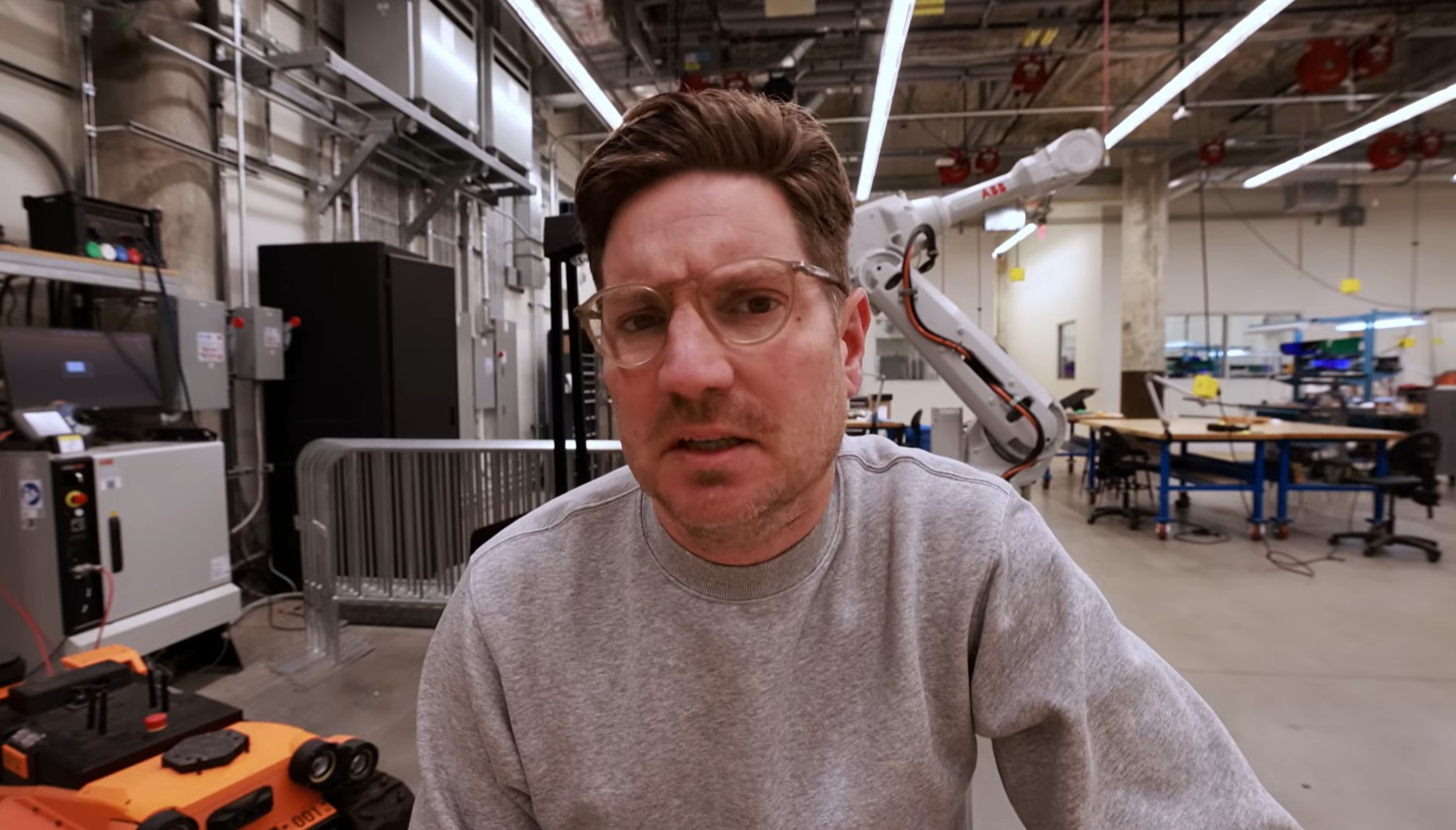
While the world remains fixated on generative chatbots and image creators, a more tangible revolution is taking place within the industrial heartland. In a detailed report released by Future in the Making, a media platform dedicated to manufacturing innovation, experts argue that Artificial Intelligence is moving beyond digital novelties to fundamentally alter the physics of the factory floor.
The report, hosted by a manufacturing specialist who relocated to Detroit two years ago to observe the industry’s evolution firsthand, suggests that the integration of “Physical AI” is the next critical frontier. This shift represents the moment “when a digital brain gets a physical body,” transforming industrial robotics from scripted automatons into intuitive teammates.
“There’s no question that we do some really impressive things, and also things are changing really fast,” the host of Future in the Making stated. “And one of the things that’s changing rapidly is AI.”
The Rise of Physical AI
The report distinguishes between the various layers of AI currently being deployed. While Large Language Models (LLMs) like ChatGPT act as “translators” between human language and machine code—simplifying tasks like writing complex Job Safety Analysis documents—the profound changes are occurring through Machine Learning and Deep Learning.
The report offers a distinct analogy for these technologies: “If machine learning is the brain, deep learning is like the eyes and ears. This is what gives machines senses.”
In practical terms, this sensory awareness allows for automated inspection systems that far surpass traditional programming. Rather than writing thousands of lines of code to define a flaw, operators can now train systems by simply drawing a box around a defect in a photograph. “It allows a machine to see a scratch on a part or hear a bearing that’s grinding,” the host explained.
From Scripted to Fluid Robotics
One of the most significant bottlenecks in traditional manufacturing has been the rigidity of industrial robots. Historically, these machines have followed strict coordinates without intuition; if a part is slightly misaligned, the process fails.
However, the report highlights breakthroughs from MIT regarding “liquid neural networks,” which allow robots to adapt to their environments in real-time. This technology is being operationalized to enable robots to adjust their grip if an object slips or slow down if a human worker approaches too closely.
“It basically turns a dumb robot into a teammate that understands physics,” the report noted.
This flexibility is already visible in advanced facilities, such as Hyundai’s Innovation Center in Singapore. There, fixed assembly lines have been replaced by flexible production cells capable of manufacturing different vehicle models simultaneously, leveraging AI to coordinate logistics and assembly in a smaller footprint.
Solving the “Dark Arts” of Engineering
AI is also demystifying complex engineering challenges, often referred to within the industry as “dark arts,” such as the design of cooling channels for injection molding. Companies like Atomic Industries are now using AI to run thousands of physics simulations, growing cooling channels organically within a mold design to prevent warping. The report describes this advancement as “using compute to effectively solve physics.”
The New Infrastructure
Despite these technological leaps, the report identifies a lingering friction point: connecting innovators with the manufacturing capacity to build their designs. To address this, the host announced the launch of Bloom, an AI-native infrastructure designed to act as a conversational engine for the supply chain. The platform utilizes autonomous agents to match engineering specifications with capable providers, aiming to democratize access to hardware production.
“The barrier to entry is gone,” the host concluded. “You don’t need a million dollars to build hardware anymore. You just need a good idea and the right tools.”