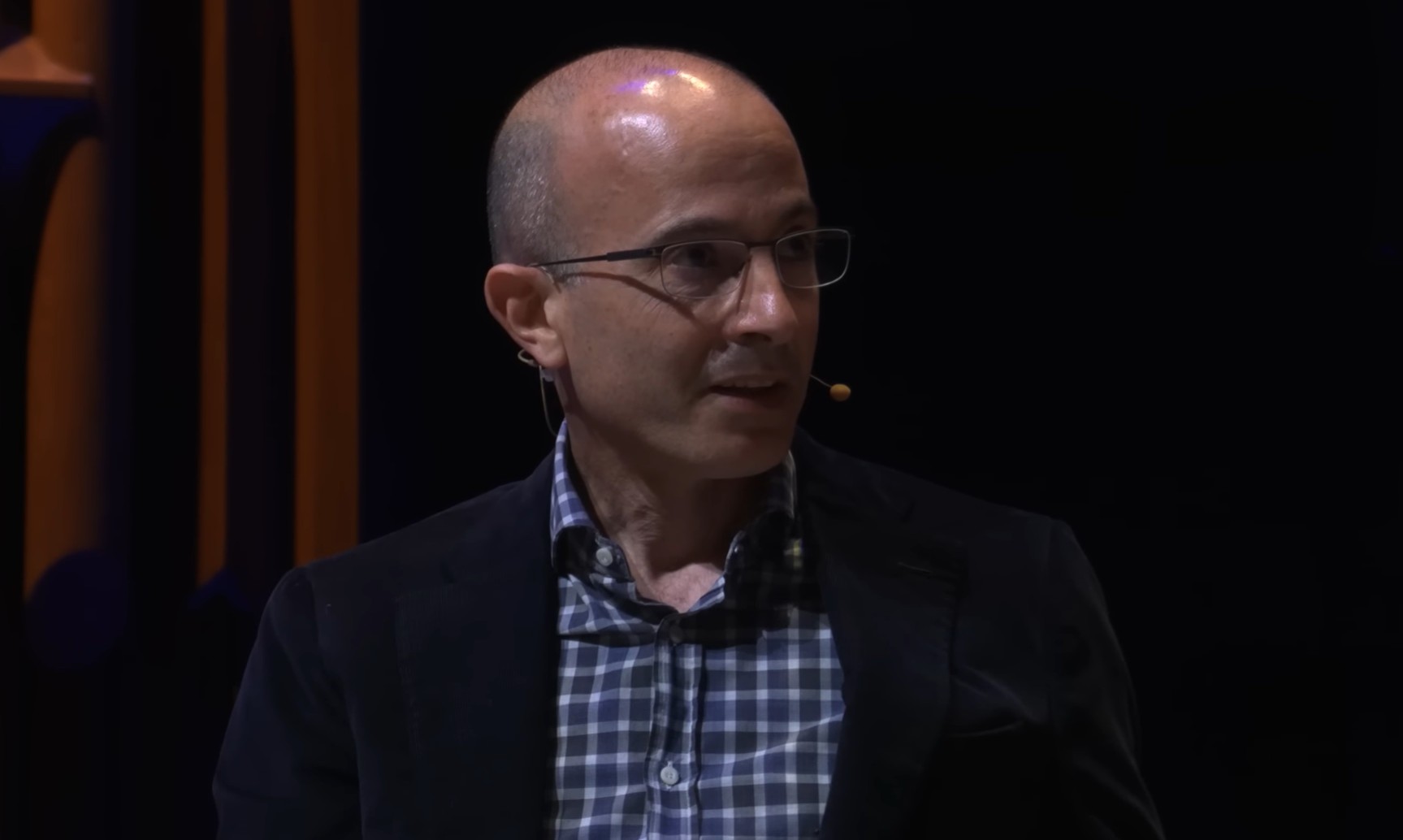
In a sweeping address regarding the fragile state of modern geopolitics and the rapid ascent of artificial intelligence, historian and philosopher Yuval Noah Harari issued a stark warning: the fundamental biological rhythms of humanity are being overrun by non-organic agents, threatening the very basis of democratic society.
Speaking at a sold-out event hosted by the HowToAcademy in London, the best-selling author of Sapiens argued that the sense of overwhelming acceleration felt globally is not merely psychological, but the result of a “clash between organic and non-organic systems.”
The End of Cycles
Harari began by diagnosing the root cause of modern exhaustion. Human beings, like all organisms, function in cycles of activity and rest. However, the economic and political systems are increasingly dominated by algorithms and AI, entities that do not require sleep or downtime.
“The thing about non-organic entities is that they don’t work in cycles… they don’t need to sleep, they don’t have families, they don’t go on vacation,” Harari told the audience. He pointed to the financial markets as a prime example, where the traditional nine-to-five trading day is being replaced by crypto-markets and algorithmic trading that function 24/7.
“If you force an organism to be active all the time, it goes mad and eventually collapses and dies,” Harari warned, suggesting that human society is currently being pushed toward this breaking point.
Democracy as Conversation
The central theme of Harari’s critique was the definition of democracy itself. He posited that democracy is not merely the act of voting, but fundamentally “a conversation.”
“If people can’t talk, they shoot, they fight,” Harari said, referencing recent political violence in the United States, including the shooting of activist Charlie Kirk. He noted that despite possessing the most sophisticated communication technology in history, humanity is losing the ability to converse. “We have the most sophisticated information and communication technology in the history of the world, and we can no longer talk with each other.”
Harari attributed this breakdown to the shift in who—or what—curates the public discourse. In the 20th century, human editors held the power to decide what questions society debated. Today, that power has been ceded to algorithms tasked with maximizing “engagement,” which Harari defined simply as keeping users glued to screens.
“The easiest way to grab human attention… to make people engaged, is to press the hate button, the anger button, the fear button,” he explained. Consequently, “trust is being shifted from human beings and human institutions to algorithms and to AIs.”
The Danger of “Bot” Rights
Harari offered a concrete policy proposal to combat the degradation of the information ecosystem: the banning of bots that impersonate humans. He challenged the notion that regulating AI output constitutes a violation of free speech.
“Bots don’t have free speech,” Harari asserted. “If a bot is communicating with me, I need to know it’s a bot and not a human being.”
He warned that without such regulation, AI could be granted legal personhood—similar to corporations—allowing non-human entities to influence politics through financial donations and automated lobbying. He described a plausible scenario where an AI accumulates wealth through cryptocurrency trading and uses it to lobby politicians to advance its own interests or rights. “This sounds like a kind of crazy science fiction scenario, but this is becoming a completely realistic scenario,” he said.
A Return to Medieval Politics
Touching on the rise of populism, Harari suggested that traditional political spectrums of “left” and “right” are becoming obsolete. Instead, global politics is reverting to a pre-modern state.
“We are more in a kind of a medieval situation when people are attached to personalities and tribes and not to ideologies,” he observed. He noted that figures like Donald Trump operate without rigid ideological constraints, allowing them to shift positions wildly while retaining support based on tribal loyalty rather than policy consistency.
Harari argued that populist leaders often exploit the language of patriotism but practice “tribalism.” True patriotism, he argued, is based on love and care for compatriots, whereas the current brand of populism relies on dividing the nation. “When they see a wound… instead of trying to heal it, they poke their finger into it and try to enlarge it… because their political career is based on division.”
Hope in Biology
Despite his grim diagnosis of the technological landscape, Harari concluded with a message of resilience rooted in biology. He reminded the audience that despite the noise of social media, human cooperation remains the bedrock of civilization. He pointed to the global trade networks that provide food and medicine as evidence of inherent human trust.
“Most humans are trustworthy. Most humans are well-meaning. Otherwise we wouldn’t be here,” he said.
To survive the 21st century, Harari urged a rejection of digital escapism and a recommitment to physical reality. He cautioned against the ancient fantasy of escaping the “messiness” of the biological body for a pure, digital existence—a fantasy now being sold by tech visionaries.
“We need to stay very connected, very rooted in its bodily, biological, organic structure,” Harari concluded. “Our minds divide us… on the level of the body, we are almost exactly the same.”