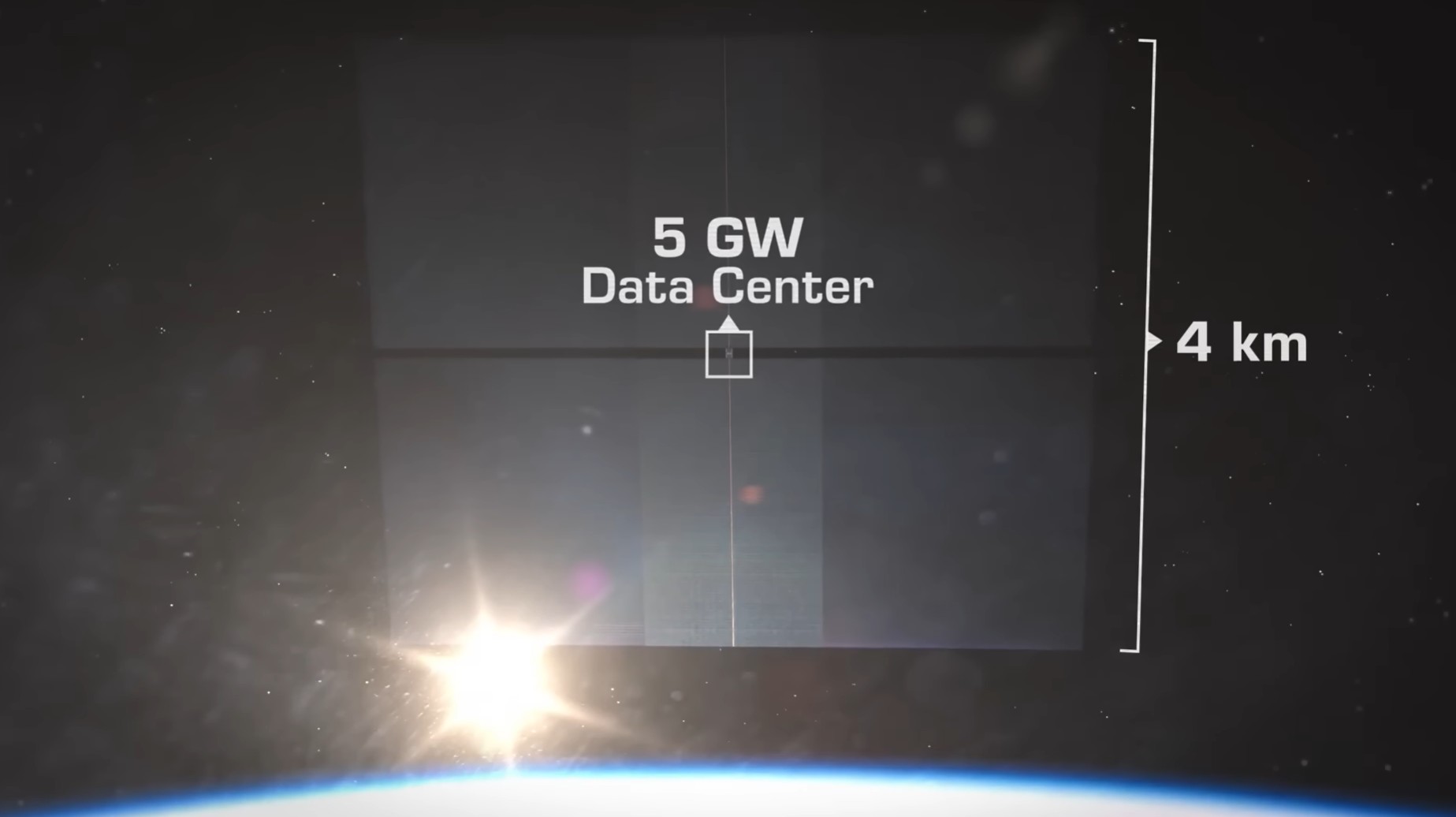
In the midst of a global boom in artificial intelligence development, a Silicon Valley startup is looking beyond the Earth’s atmosphere to solve the energy crisis facing terrestrial data centers. Lumen Orbit, backed by the prestigious tech accelerator Y Combinator, recently published a white paper proposing the construction of massive orbital data centers for AI training.
However, according to Scott Manley, a prominent astrophysicist and spaceflight analyst, the proposal faces significant physical and economic challenges that may be harder to overcome than gravity itself.
In a comprehensive analysis released this week, Manley broke down Lumen Orbit’s pitch: relocating power-hungry compute clusters to space to leverage 24/7 solar energy and the cold vacuum for cooling.
“Their pitch is they want to put data centers in space,” Manley explained. “They do some back-of-the-envelope math which explains why they think that data centers in space are the way forward for giant compute jobs such as training AI data sets.”
The Energy Argument
The primary driver for the concept is the insatiable power demand of modern AI processors. On Earth, data centers are increasingly constrained not by the availability of hardware, but by the local grid’s ability to supply electricity and cooling.
Lumen Orbit argues that if launch costs fall significantly—relying heavily on vehicles like SpaceX’s Starship—space becomes economically viable. They propose a 5-gigawatt facility utilizing solar arrays spanning kilometers.
“Solar panels in orbit which are exposed to sun 24 hours a day and are above the atmosphere and above any weather will produce power more cheaply than solar panels on the ground,” Manley noted, summarizing the startup’s economic thesis.
However, Manley expressed skepticism regarding the financial projections, which suggest an orbital facility could cost a fraction of a terrestrial counterpart over a decade. “I don’t think all of these numbers are correct,” Manley stated. “I think there’s a number of problems that they haven’t really addressed.”
The Cooling Paradox
The most significant technical hurdle, according to Manley, is thermal management. While space is famously cold, the vacuum acts as a near-perfect insulator, making it incredibly difficult to shed the waste heat generated by high-performance computing.
“The most important kind of radiation when you’re putting data centers in space is thermal radiation… because you are going to have to keep everything cool,” Manley said.
He debunked the popular misconception that the cold of space naturally freezes objects. “While the average person on the street knows that space can be very, very cold, it’s not very good at cooling things because it’s a vacuum. That’s why vacuum flasks are used to keep things cold or warm.”
To function, these satellites would require massive radiators to expel heat. This adds significant mass and drag, particularly if the satellites are placed in lower orbits to minimize latency.
Orbital Dynamics and Debris
To achieve the 24/7 solar power required for continuous operation, Lumen Orbit proposes using a Sun-Synchronous Orbit (SSO). This specific orbital path keeps a satellite largely in continuous sunlight. However, Manley pointed out that SSO is prime real estate and already crowded.
“Sun-synchronous orbits are very busy,” Manley warned. “And if you’ve got a busy part of space, the last thing you want is a giant 4 kilometer wide solar panel that is going to hit every piece of space debris.”
Furthermore, such a massive structure in a relatively low orbit would experience significant atmospheric drag, requiring constant propulsion to stay aloft. Moving to higher orbits to avoid drag introduces new problems, specifically the Van Allen radiation belts, which would degrade solar panels and damage sensitive electronics.
The “Data Bus”
Perhaps the most novel solution to the bandwidth problem—how to move petabytes of training data to and from orbit—is physical transportation. Rather than beaming data via radio, which is slow and bandwidth-constrained, Lumen Orbit proposes launching storage drives physically.
“Load all your data onto a spacecraft and send it up there,” Manley observed. “Sort of a space version of a bus. A data bus.”
A High-Risk Venture
While acknowledging the pedigree of Y Combinator—which incubated giants like Airbnb, Reddit, and Dropbox—Manley remained cautious about the startup’s timeline and technical assumptions.
“For every big success that comes out of one of these, you’re going to have nine companies that didn’t quite make it,” Manley said. “I will be completely unsurprised if Lumen Orbit is one of those nine that fail.”
Despite the skepticism, Manley conceded that the concept represents a fascinating intersection of space infrastructure and AI demand. If the industry can solve the immense challenges of radiative cooling and orbital debris, off-world computing could eventually become a reality, though likely not at the costs or timelines currently projected.
“There is absolutely an objective gain to be had by doing this if you can solve all those other problems,” Manley concluded.